Atmospheric Heat Treatment plays a critical role in improving the hardness, wear resistance, and fatigue strength of industrial components.
From automotive gears to heavy-duty shafts and forged parts, this process ensures materials meet strict mechanical and dimensional requirements. However, like any thermal process, improper control can lead to defects that compromise component performance and increase production costs.
Even minor deviations in temperature, atmosphere composition, or quenching parameters can result in oxidation, decarburization, distortion, or cracking. These defects not only affect product quality but also cause rework, rejection, and customer dissatisfaction.
Understanding the common defects in Atmospheric Heat Treatment — and how to prevent them — is essential for maintaining consistent metallurgical performance and operational efficiency.
Why Defects Occur in Atmospheric Heat Treatment
Defects typically arise due to poor process control or equipment limitations. The most common contributing factors include:
- Improper carbon potential control
- Oxygen infiltration into the furnace
- Temperature non-uniformity
- Inadequate quenching practices
- Furnace leakage
- Overloading of components
- Material chemistry inconsistencies
Because
Atmospheric Heat Treatment relies on controlled gaseous environments, precise monitoring of temperature and atmosphere composition is crucial. Any imbalance can directly affect surface chemistry and microstructure transformation.
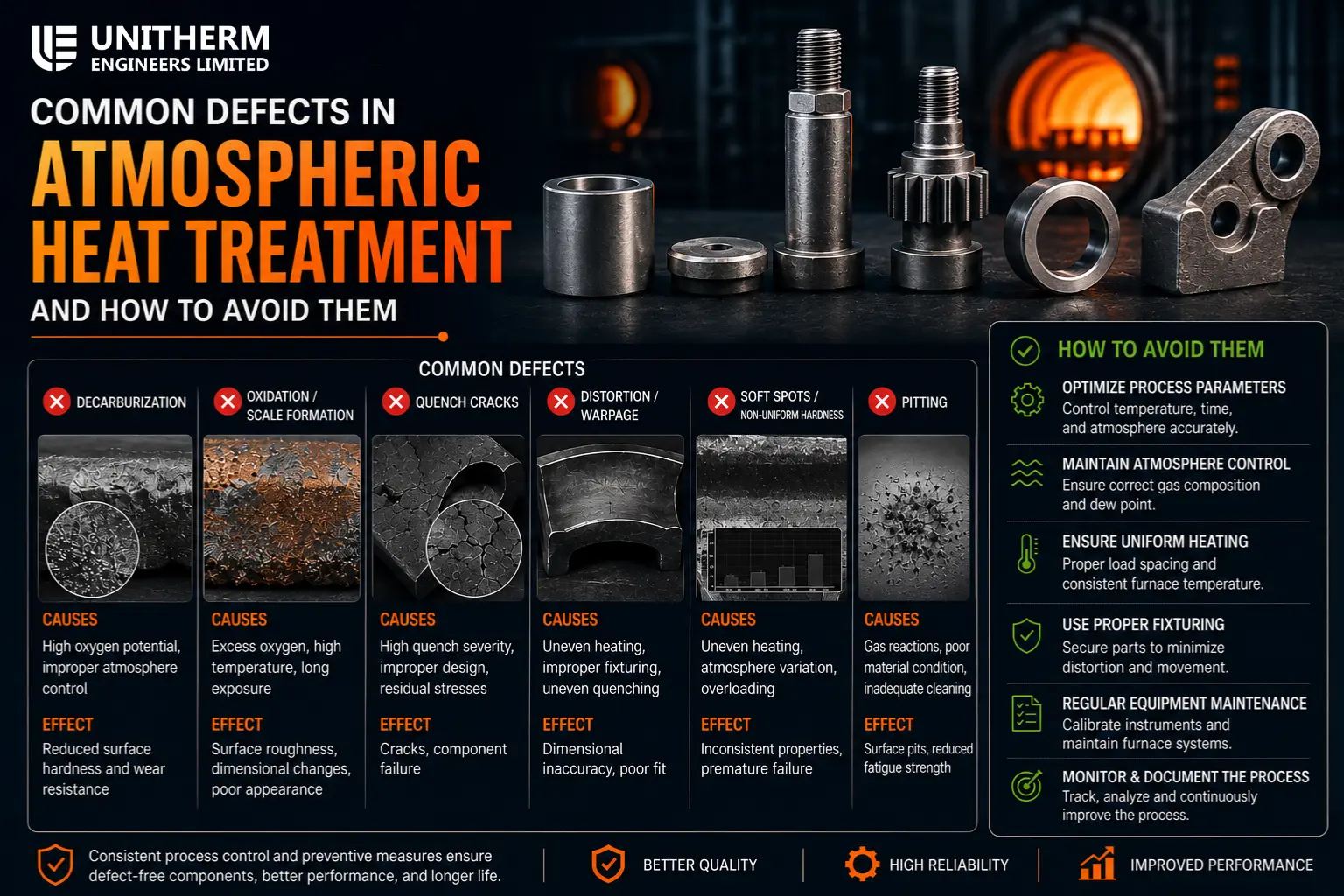
Common Defects in Atmospheric Heat Treatment
1.Oxidation & Scaling
Cause:
Oxidation occurs when oxygen reacts with heated metal surfaces, forming iron oxide scale. This often happens due to furnace leakage or improper atmosphere control.
Impact:
- Surface roughness
- Dimensional loss
- Increased machining requirements
- Reduced surface quality
Prevention:
- Maintain proper furnace sealing
- Ensure positive pressure inside the chamber
- Monitor oxygen levels with probes
- Regularly inspect door seals and gas lines
Controlled atmosphere management is the primary defense against oxidation.
2.Decarburization
Cause:
Decarburization happens when carbon is lost from the steel surface due to exposure to oxygen or low carbon potential.
Impact:
- Reduced surface hardness
- Weak fatigue resistance
- Premature component failure
Since carbon is critical for hardness, decarburization significantly undermines the purpose of Atmospheric Heat Treatment.
Prevention:
- Maintain proper carbon potential levels
- Calibrate carbon probes regularly
- Avoid excessive furnace exposure time
3.Uneven Carburization or Inconsistent Case Depth
Cause:
Uneven case depth typically results from poor gas circulation, improper loading patterns, or inconsistent temperature distribution.
Impact:
- Non-uniform hardness
- Localized weak zones
- Performance failure under load
In
automotive gear applications, inconsistent case depth can lead to pitting and fatigue cracks.
Prevention:
- Optimize furnace loading patterns
- Avoid overcrowding components
- Maintain uniform furnace temperature
- Verify gas circulation efficiency
Regular case depth measurement ensures early detection of inconsistencies.
4.Distortion & Warping
Cause:
Rapid quenching, uneven heating, or poor fixturing can cause distortion during cooling.
Impact:
- Dimensional inaccuracy
- Assembly misalignment
- Increased machining cost
- Rejection of precision parts
Although distortion is common in
hardening processes, it can be minimized with proper planning.
Prevention:
- Use optimized fixturing techniques
- Control quenching rate and agitation
- Conduct stress-relieving prior to hardening
- Ensure uniform temperature distribution
Modern Atmospheric Heat Treatment systems integrate quench controls to minimize thermal shock.
5.Cracking
Cause:
Cracking often occurs due to excessive internal stresses generated during rapid quenching or due to high carbon content in combination with sharp component geometry.
Impact:
- Complete component rejection
- Safety risks
- Increased scrap rate
Cracks may not always be visible and can propagate during service.
Prevention:
- Optimize quenching speed
- Use appropriate quench media
- Perform tempering immediately after hardening
- Avoid sharp design transitions
Tempering is essential to relieve residual stresses and reduce crack formation risk.
6.Soft Spots
Cause:
Soft spots occur due to uneven heating or inadequate quenching, leading to incomplete martensitic transformation.
Impact:
- Reduced wear resistance
- Localized failure zones
- Inconsistent mechanical properties
Prevention:
- Conduct regular temperature uniformity surveys (TUS)
- Ensure adequate quench agitation
- Maintain consistent furnace temperature
- Avoid sharp design transitions
Hardness testing across multiple locations can identify soft zones early.
Process Control Measures in Atmospheric Heat Treatment
Preventing defects requires a structured process control system. Key monitoring tools include:
- Carbon potential analyzers
- Oxygen probes
- Dew point sensors
- Automated gas flow controllers
- Temperature uniformity validation
- Preventive furnace maintenance schedules
Automation significantly reduces human error and improves repeatability. Digital process logging also helps track deviations and maintain traceability.
Quality Inspection & Testing
Effective inspection ensures that defects are detected before shipment. Standard quality checks include:
- Surface hardness testing (Rockwell scale)
- Effective case depth measurement
- Microstructure analysis
- Dimensional inspection
- Surface integrity examination
Regular metallurgical audits help maintain process stability and ensure consistent performance.
Best Practices to Minimize Heat Treatment Defects
To maintain high reliability in Atmospheric Heat Treatment, manufacturers should:
- Implement standardized operating procedures
- Maintain strict furnace calibration schedules
- Optimize loading patterns
- Train operators regularly
- Conduct preventive maintenance
- Monitor process data continuously
Consistency in process control directly translates to lower rejection rates and improved customer satisfaction.
Economic Impact of Heat Treatment Defects
Defects in Atmospheric Heat Treatment can significantly increase operational costs through:
- Rework and reprocessing
- Scrap material loss
- Production delays
- Increased inspection time
- Customer returns and warranty claims
Investing in preventive measures and advanced monitoring systems often provides a strong return on investment by reducing long-term losses.
Conclusion
While Atmospheric Heat Treatment is a reliable and widely used industrial process, it requires precise control to avoid defects such as oxidation, decarburization, distortion, cracking, and soft spots. Most of these issues are preventable through proper furnace maintenance, atmosphere monitoring, temperature control, and quality inspection.
By implementing strong process controls and best practices, manufacturers can significantly reduce rejection rates, improve component reliability, and enhance overall production efficiency. In competitive industries where performance and consistency are critical, defect prevention is not just a technical requirement — it is a strategic advantage.
FAQs
1.What are the most common defects in Atmospheric Heat Treatment?
The most common defects in Atmospheric Heat Treatment include oxidation, scaling, decarburization, distortion, cracking, uneven case depth, and soft spots. These issues typically arise due to improper temperature control, poor atmosphere management, or incorrect quenching practices.
2.What causes oxidation during Atmospheric Heat Treatment?
Oxidation occurs when oxygen reacts with heated metal surfaces inside the furnace. It is usually caused by furnace leakage, inadequate sealing, or improper atmosphere control, leading to scale formation and surface roughness.
3.How can decarburization be prevented in heat treatment?
Decarburization can be prevented by maintaining proper carbon potential levels, ensuring accurate carbon probe calibration, minimizing oxygen exposure, and controlling furnace atmosphere composition throughout the cycle.
What causes cracking in Atmospheric Heat Treatment?
Cracking is typically caused by excessive quenching stress, high carbon content, sharp component geometry, or inadequate tempering after hardening. Proper quench rate control and timely tempering significantly reduce cracking risks.