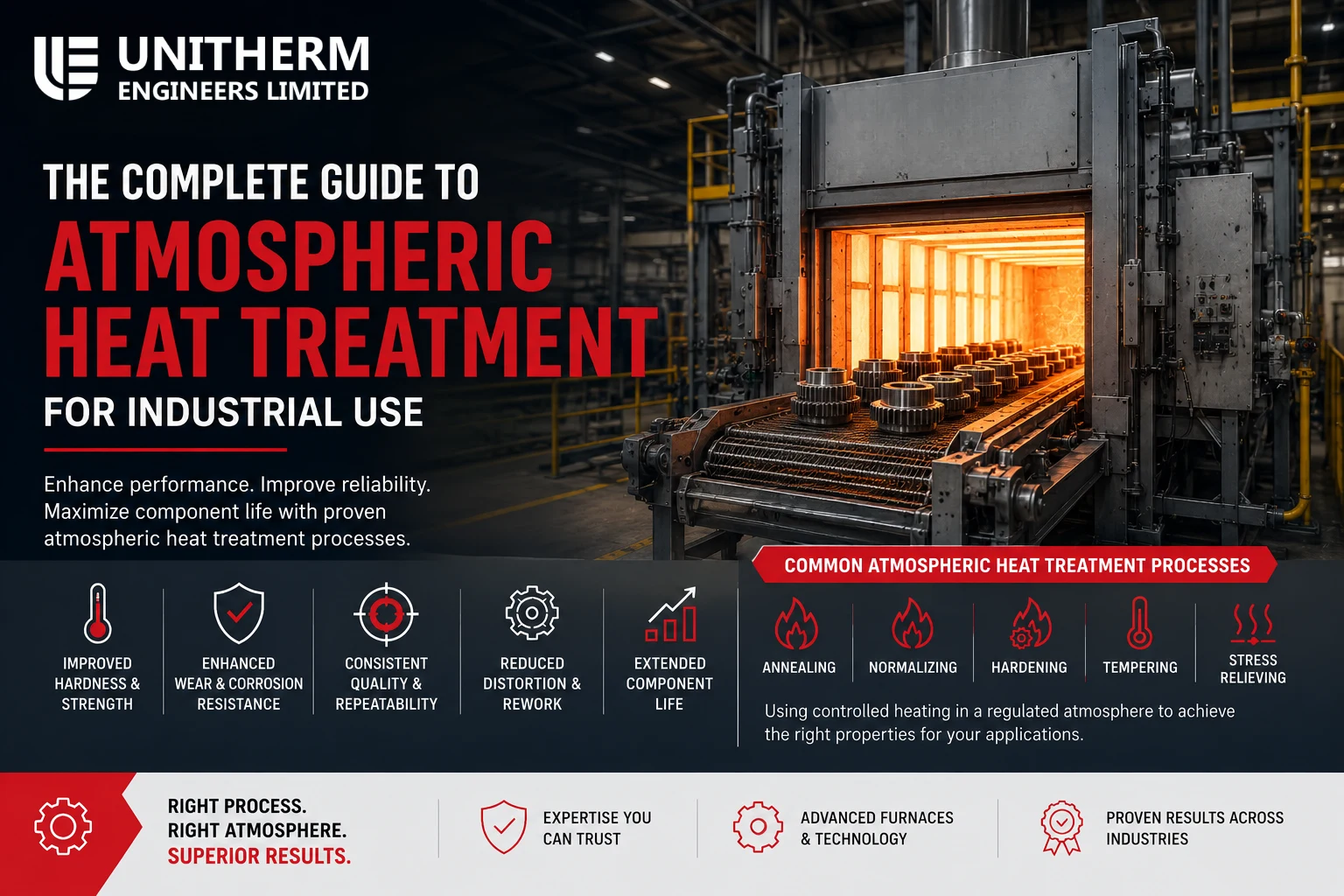
Atmospheric Heat Treatment is one of the most established and industrially reliable metallurgical processes used to enhance the mechanical and structural performance of steel and alloy components. Across industries such as automotive, aerospace, forging, tooling, heavy engineering, and die & mould manufacturing, heat treatment plays a decisive role in determining product durability, wear resistance, load-bearing capacity, and service life.
In modern manufacturing, material selection alone is not enough to guarantee performance. Components must withstand cyclic stresses, friction, impact loads, and harsh operating environments. This is where Atmospheric Heat Treatment becomes critical. By precisely controlling temperature, time, and gaseous atmosphere composition inside industrial furnaces, manufacturers can modify microstructure, refine grain size, alter surface chemistry, and achieve consistent hardness profiles.
Unlike open-air heating processes that result in oxidation and decarburization, Atmospheric Heat Treatment uses controlled gaseous environments — such as endothermic gas, nitrogen-based mixtures, or carbon-enriched atmospheres — to protect and actively engineer the metal surface. This enables advanced surface hardening techniques like carburizing, carbonitriding, nitriding, annealing, normalizing, hardening, and tempering to be performed with repeatable accuracy.
The importance of this process extends beyond hardness improvement. Atmospheric Heat Treatment directly influences:
- Surface wear resistance
- Core toughness
- Fatigue strength
- Dimensional stability
- Microstructural transformation
- Resistance to cracking and failure
For industries manufacturing gears, shafts, bearings, dies, stamping tools, forged components, aerospace parts, and automotive tool steels, even minor variations in heat treatment can result in premature failure, distortion, or costly rejections. Therefore, understanding process parameters, distortion control, microstructure development, and application-specific requirements is essential.
This comprehensive guide explores Atmospheric Heat Treatment from both technical and industrial perspectives. We will examine:
- Surface hardening processes and case formation
- Distortion and fixturing control strategies
- Metallurgical phase transformations and microstructure engineering
- Industry-specific applications across automotive, aerospace, forging, and tooling sectors
- Process optimization techniques for improved consistency and quality
Whether you are a manufacturing engineer, quality manager, design specialist, or procurement decision-maker, this pillar resource provides a complete understanding of how Atmospheric Heat Treatment enhances performance, improves reliability, and supports large-scale industrial production.
By the end of this guide, you will gain clarity on how to select the right heat treatment method, control process variables effectively, and optimize component performance for demanding industrial applications.
1.What is Atmospheric Heat Treatment?
Atmospheric Heat Treatment is a thermal processing method where metals are heated in controlled gas atmospheres such as:
- Endothermic gas
- Nitrogen-based atmospheres
- Carbon-enriched gases
- Ammonia blends
The atmosphere prevents oxidation and allows control over carbon or nitrogen diffusion into steel surfaces.
This method is widely used for:
2.Surface Hardening in Atmospheric Heat Treatment
Surface hardening is one of the most critical applications of Atmospheric Heat Treatment.
-
Carburizing vs Carbonitriding
Carburizing introduces carbon into the steel surface, while carbonitriding introduces both carbon and nitrogen to improve hardness and wear resistance.
-
Nitriding and Microstructure Benefits
Nitriding enhances fatigue strength and creates a hard diffusion layer without quenching.
-
Case Hardening for Wear Resistance
Case hardening improves surface durability while maintaining a tough core — ideal for gears and shafts.
-
Induction Hardening vs Atmospheric Hardening
Induction hardening provides localized heating, while Atmospheric Heat Treatment enables bulk processing and deeper case formation.
3.Distortion & Fixturing Control in Atmospheric Heat Treatment
Dimensional stability is a critical concern in heat treatment.
❖ Causes of Distortion
Distortion occurs due to:
- Uneven heating
- Rapid quenching
- Phase transformation stresses
- Improper support
❖ Importance of Customised Fixturing
Proper fixturing ensures:
- Uniform heat exposure
- Reduced movement during quenching
- Repeatable dimensional accuracy
❖ Controlled Cooling & Stability
Cooling rate directly impacts residual stress and dimensional change.
❖ Process Optimization Techniques
Modern atmospheric furnaces integrate:
- PLC controls
- Carbon potential monitoring
- Predictive maintenance
- Load simulation
4.Microstructure & Metallurgy in Atmospheric Heat Treatment
Understanding phase transformations is essential to controlling final material properties.
❖ Austenite to Martensite Transformation
When steel is heated above critical temperature, it forms austenite. Upon rapid cooling, it transforms into martensite — a hard but brittle structure.
❖ Retained Austenite & Tool Life
Improper cooling may leave retained austenite, affecting wear resistance and dimensional stability.
❖ Grain Size Control
Grain refinement improves toughness and strength.
❖ Carbide Distribution in Tool Steels
Uniform carbide dispersion ensures consistent wear resistance.
❖ Metallurgical Failures
Improper heat treatment can cause:
- Cracking
- Soft spots
- Warping
- Premature failure
5.Industry-Specific Applications of Atmospheric Heat Treatment
❖ Forging Industry
Improves mechanical strength and fatigue life in forged components.
❖ Stamping Tools & Dies
Ensures hardness and wear resistance in high-pressure tooling.
❖ Aerospace Components
Critical for strength-to-weight optimization and fatigue performance.
❖ Automotive Tool Steel Hardening
Vital for gears, shafts, transmission parts, and structural components.
❖ Die & Mould Industry
Precision heat treatment enhances mould longevity and performance.
6.Advantages of Atmospheric Heat Treatment
- ✔ Cost-effective for mass production
- ✔ Suitable for large components
- ✔ Effective surface hardening
- ✔ Flexible batch and continuous processing
- ✔ Industry-proven reliability
7.Quality Assurance & Testing
To ensure consistency:
- Hardness testing (Rockwell, Vickers)
- Microstructure analysis
- Case depth measurement
- Carbon potential validation
- Dimensional inspection
8.Why Atmospheric Heat Treatment Remains Industry Standard
Despite emerging technologies, Atmospheric Heat Treatment remains dominant due to:
- Scalability
- Process familiarity
- Cost efficiency
- Wide material compatibility
- Established industrial infrastructure
Conclusion
Atmospheric Heat Treatment continues to be a foundational process in modern industrial manufacturing due to its versatility, scalability, and cost-effectiveness. From surface hardening and case formation to microstructure refinement and distortion control, it plays a critical role in improving the performance and durability of steel components across multiple industries.
By precisely controlling furnace temperature, time cycles, and gas atmosphere composition, manufacturers can achieve consistent metallurgical properties such as enhanced hardness, improved wear resistance, increased fatigue strength, and optimized dimensional stability. Whether applied to automotive gears, forging components, aerospace parts, stamping tools, or die and mould systems, Atmospheric Heat Treatment directly impacts product reliability and lifecycle performance.
However, achieving optimal results requires more than simply heating and cooling metal. Success depends on:
- Proper atmosphere control
- Accurate carbon potential monitoring
- Controlled cooling strategies
- Customised fixturing
- Microstructure evaluation
- Process optimization
When executed correctly, Atmospheric Heat Treatment reduces rejection rates, enhances production efficiency, and ensures compliance with industrial quality standards.
As manufacturing demands continue to evolve, integrating advanced furnace controls, digital monitoring, and metallurgical expertise will remain essential for maintaining competitive advantage. Companies that invest in optimized Atmospheric Heat Treatment processes position themselves for superior component performance and long-term operational reliability.
Looking for Reliable Atmospheric Heat Treatment Solutions?
Whether you need:
- Carburizing for gears
- Nitriding for fatigue resistance
- Case hardening for wear components
- Distortion-controlled processing
- Industry-specific heat treatment solutions
Our advanced controlled atmosphere furnaces deliver precision, repeatability, and metallurgical consistency.
☑ Automotive-grade quality control
☑ Optimized process parameters
☑ Custom fixturing support
☑ Metallurgical analysis & validation
📊 Get a process evaluation for your components
Partner with us to improve component life, reduce rejection rates, and enhance performance.
Frequently Asked Questions
Why is atmosphere control important in heat treatment?
Atmosphere control prevents oxidation and decarburization while allowing precise control of carbon or nitrogen diffusion into the steel surface. This ensures consistent hardness, case depth, and microstructural integrity.
What gases are used in Atmospheric Heat Treatment?
Common gases include endothermic gas, nitrogen-based mixtures, hydrogen blends, carbon-enriched gases, and ammonia (for nitriding). The gas composition depends on the specific process being performed.
How does Atmospheric Heat Treatment reduce distortion?
Distortion can be minimized through controlled heating rates, uniform atmosphere distribution, proper fixturing, and optimized cooling cycles. Controlled cooling plays a significant role in maintaining dimensional stability.
What industries use Atmospheric Heat Treatment?
Industries such as automotive, aerospace, forging, tooling, heavy engineering, die & mould manufacturing, and stamping operations rely heavily on Atmospheric Heat Treatment for component performance enhancement.
How is quality verified after heat treatment?
Quality checks typically include hardness testing, microstructure analysis, case depth measurement, dimensional inspection, and carbon potential verification to ensure consistent metallurgical properties.
Is Atmospheric Heat Treatment suitable for high-volume production?
Yes. Atmospheric Heat Treatment is highly scalable and cost-effective, making it ideal for continuous production lines and large batch processing in industrial manufacturing.