In modern manufacturing,
Atmospheric Heat Treatment plays a critical role in achieving precise mechanical properties in steel components. Among all process variables, carbon potential stands out as one of the most important parameters controlling
surface hardness, case depth, and microstructure development.
Whether manufacturing automotive gears, shafts, bearings, or industrial tooling, maintaining the correct carbon potential inside a
controlled atmosphere furnace determines the success of the entire heat treatment cycle.
This article explains what carbon potential is, why it matters, how it is measured, and how manufacturers can optimize it for consistent, defect-free results.
What is Carbon Potential?
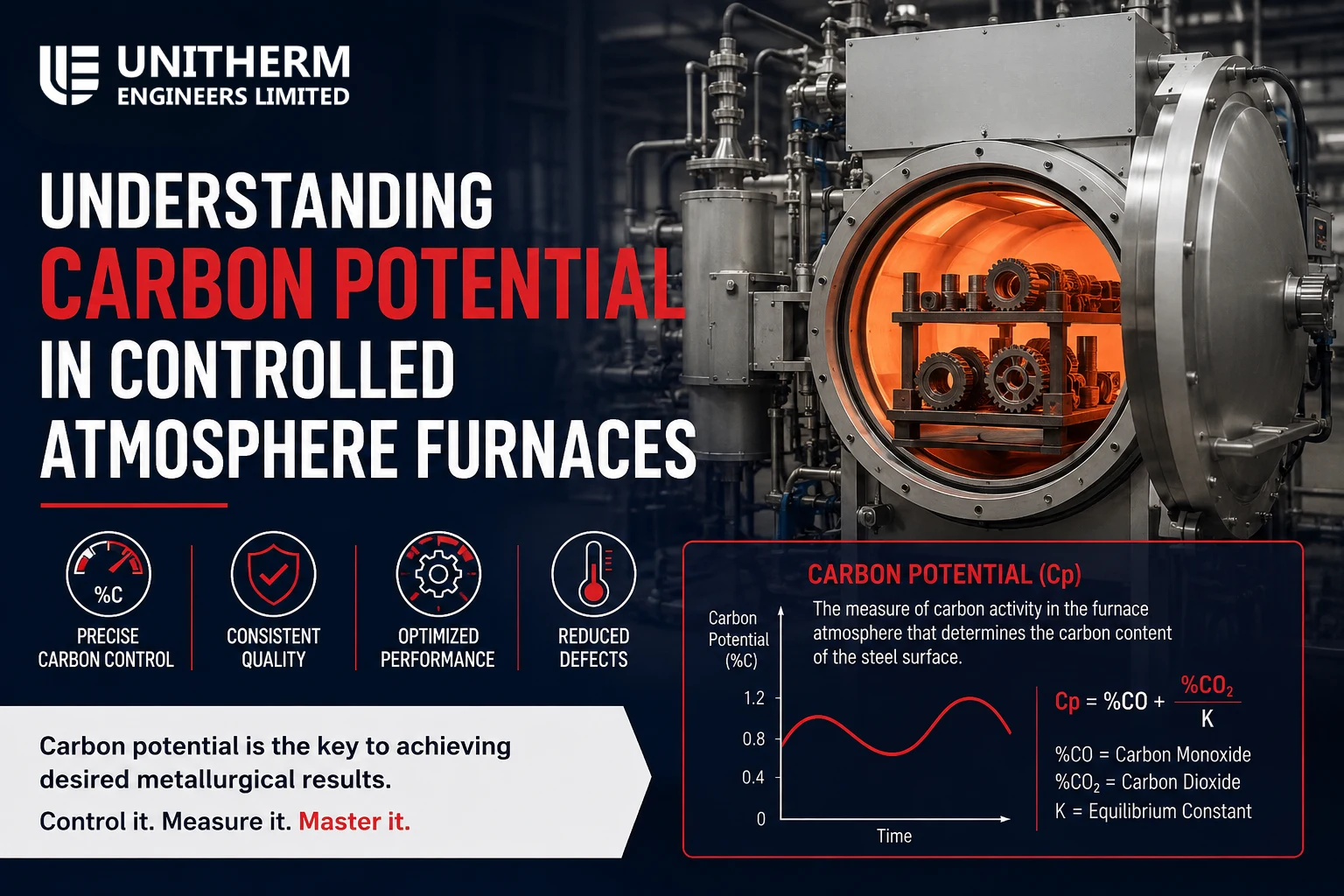
Carbon potential refers to the amount of carbon available in the furnace atmosphere that can be absorbed by the steel surface during heat treatment. In simpler terms, it represents the carbon concentration the atmosphere is capable of transferring to the material at a given temperature.
During
carburizing in
Atmospheric Heat Treatment , the furnace atmosphere interacts with the steel surface. If the atmosphere has a higher carbon potential than the steel surface, carbon diffuses into the material. If it is lower, decarburization can occur.
It is important to understand the distinction between:
-
Surface carbon content – Carbon concentration at the outer layer
-
Core carbon content – Carbon percentage within the base material
-
Case depth – Depth to which carbon has diffused
The goal of carbon potential control is to create the desired carbon gradient from the surface inward, ensuring optimal hardness and wear resistance without compromising toughness.
Role of Carbon Potential in Atmospheric Heat Treatment
Carbon potential directly influences:
- Surface hardness
- Case depth
- Microstructure formation
- Fatigue resistance
- Wear performance
In
gas carburizing processes ,carbon diffuses into steel at elevated temperatures, typically between 850°C and 950°C. A properly controlled atmosphere ensures that carbon diffusion occurs uniformly across all components.
If carbon potential is too low:
- Decarburization occurs
- Surface hardness decreases
- Reduced wear resistance
If carbon potential is too high:
- Carbide networks may form
- Surface brittleness increases
- Soot deposition can occur inside the furnace
Therefore, precise control ensures consistent metallurgical properties across production batches.
How Carbon Potential is Measured
Modern controlled atmosphere furnaces use advanced monitoring systems to measure and regulate carbon potential in real time.
1. Oxygen Probes
Oxygen probes are the most common tools used to monitor carbon potential. They measure oxygen partial pressure in the furnace atmosphere and calculate carbon potential based on thermodynamic relationships.
2.CO/CO₂ Ratio Monitoring
The carbon potential is also influenced by the ratio of carbon monoxide (CO) to carbon dioxide (CO₂) in the furnace atmosphere. Continuous gas analysis helps maintain equilibrium conditions.
3. Dew Point Measurement
Dew point measurement helps monitor moisture levels, which affect oxidation and decarburization risk.
4. Closed-Loop Control Systems
Modern
Atmospheric Heat Treatment systems use PLC-based automation to adjust enrichment gas automatically, maintaining stable carbon potential throughout the cycle.
Regular probe calibration is essential to avoid drift and inaccurate readings.
Factors Affecting Carbon Potential
Gas Composition
Endothermic gas, natural gas enrichment, or methanol injection determines the available carbon in the atmosphere. Improper gas mixing can destabilize carbon levels.
Temperature
Higher temperatures increase carbon diffusion rates. However, temperature must be coordinated with carbon potential to prevent excessive case formation.
Furnace Sealing
Air infiltration introduces oxygen, reducing carbon potential and increasing oxidation risks.
Load Configuration
Improper component spacing restricts gas circulation, leading to uneven case depth.
Carbon Potential and Case Depth Relationship
One of the primary objectives in
carburizing is achieving the correct case depth. This is often controlled through a boost-diffuse cycle:
-
Boost Phase: High carbon potential to quickly enrich the surface.
-
Diffuse Phase: Lower carbon potential to allow carbon to penetrate deeper without excessive surface concentration.
This controlled gradient ensures:
- High surface hardness
- Gradual transition to tough core
- Improved fatigue resistance
Hardness testing and metallographic analysis are typically used to verify the achieved case depth and microstructure.
Common Carbon Potential Problems & Solutions
Improper control of carbon potential can result in several manufacturing defects:
1.Decarburization
Cause:Low carbon potential or air infiltration
Solution: Increase enrichment gas and check furnace sealing.
2.Soot Formation
Cause:Excessive carbon potential
Solution: Adjust CO/CO₂ ratio and reduce enrichment flow.
3.Uneven Case Depth
Cause:Poor gas circulation or improper loading
Solution: Optimize load spacing and improve atmosphere flow.
4.Over-Carburizing
Cause:Excessively high carbon levels
Solution: Fine-tune carbon potential during boost phase.
Proactive monitoring and preventive maintenance significantly reduce these issues.
Importance in Automotive and Industrial Applications
In
automotive manufacturing, gears and shafts require:
- High surface hardness
- Strong fatigue resistance
- Dimensional stability
Precise carbon potential control ensures these components perform reliably under cyclic loads.
Industrial tooling and heavy machinery components also depend on consistent
Atmospheric Heat Treatment processes to extend service life and reduce downtime.
Poor carbon control can result in premature failure, increased scrap rates, and higher production costs.
Advanced Control Techniques in Modern Furnaces
With Industry 4.0 integration, furnace systems now include:
- PLC-based atmosphere regulation
- SCADA monitoring systems
- Data logging and traceability
- Predictive maintenance algorithms
- Automated gas flow adjustments
These technologies allow manufacturers to achieve tighter carbon potential tolerances and better batch consistency.
Real-time data tracking also helps maintain compliance with quality standards and audit requirements.
Best Practices for Optimizing Carbon Potential
To ensure consistent results in
Atmospheric Heat Treatment, manufacturers should follow these best practices:
- Regular oxygen probe calibration
- Routine furnace maintenance
- Temperature uniformity surveys
- Proper load spacing
- Continuous gas composition monitoring
- Periodic metallurgical verification
- Documentation of process parameters
A structured quality control system reduces variability and ensures repeatable results.
Conclusion
Carbon potential is the backbone of successful controlled atmosphere carburizing. It directly determines surface hardness, case depth, and overall component performance.
In
Atmospheric Heat Treatment, maintaining the correct carbon equilibrium inside the furnace is essential for producing high-quality, durable components. By combining precise monitoring systems, automated control technologies, and disciplined maintenance practices, manufacturers can significantly reduce defects, improve process reliability, and enhance product performance.
As industries continue to demand tighter tolerances and longer component life, mastering carbon potential control is no longer optional—it is a competitive necessity.
FAQs
1.What is carbon potential in Atmospheric Heat Treatment?
Carbon potential is the amount of carbon available in the furnace atmosphere that can be absorbed by the steel surface during carburizing. In Atmospheric Heat Treatment, it determines how much carbon diffuses into the component and directly affects surface hardness and case depth.
2.What is carbon potential in Atmospheric Heat Treatment?
Oxidation occurs when oxygen reacts with heated metal surfaces inside the furnace. It is usually caused by furnace leakage, inadequate sealing, or improper atmosphere control, leading to scale formation and surface roughness.
3.What happens if carbon potential is too low?
Decarburization can be prevented by maintaining proper carbon potential levels, ensuring accurate carbon probe calibration, minimizing oxygen exposure, and controlling furnace atmosphere composition throughout the cycle.
If carbon potential is too low during Atmospheric Heat Treatment:
- Surface decarburization may occur
- Reduced surface hardness
- Lower wear resistance
- Poor fatigue strength
This can lead to premature component failure.
4.How does carbon potential affect case depth?
Carbon potential directly influences the amount of carbon absorbed at the surface. A higher carbon potential during the boost phase increases surface carbon concentration, while a controlled diffusion phase helps achieve the required case depth without over-carburizing.