Blog

Carbonitriding Process: Enhancing Surface Strength and Durability in Heat Treatment

carbonitriding heat treatment
In modern manufacturing, precision, strength, and durability are the foundation of quality products. Whether it’s gears, fasteners, or machine components, their performance depends largely on the heat treatment process used to strengthen them. Among various methods, the carbonitriding process has emerged as one of the most effective and economical techniques for enhancing surface hardness and wear resistance.
Let’s explore what carbonitriding is, how it works, and why it’s widely used in commercial heat treating operations across industries.
What Is the Carbonitriding Process?

The carbonitriding process is a thermochemical heat treatment process that simultaneously introduces carbon and nitrogen into the surface of steel or alloy components. This controlled diffusion hardens the outer layer of the metal while maintaining a tough, ductile core.
In simple terms, carbonitriding combines the best properties of carburizing and nitriding processes —achieving deeper case hardening with improved wear resistance and fatigue strength.
Industries like automotive, heavy machinery, and tool manufacturing rely on carbonitriding for components that endure continuous friction, load, and high stress.

How Does the Carbonitriding Process Work?

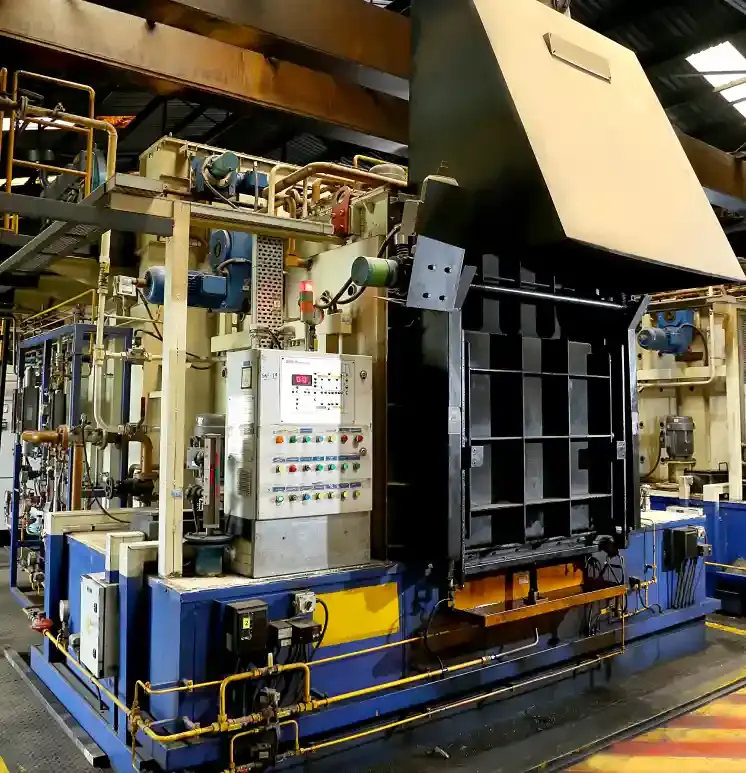
The carbonitriding process typically takes place in a controlled-atmosphere furnace, where steel components are heated between 800°C to 900°C. The process involves the following steps:
  1. Heating: Parts are heated to the desired temperature in a sealed furnace.
  2. Gas Introduction: A gas mixture containing hydrocarbons (for carbon) and ammonia (for nitrogen) is introduced into the chamber.
  3. Diffusion: Both carbon and nitrogen atoms diffuse into the steel surface, forming a hard, wear-resistant layer.
  4. Quenching: The component is then rapidly cooled in oil or gas to lock in the desired hardness.
This controlled process ensures uniform case depth, improved surface quality, and minimized distortion — key aspects of precision heat treating services .

Key Benefits of the Carbonitriding Process

The carbonitriding process offers several advantages that make it ideal for high-performance components:
  • Superior Surface Hardness: Enhances resistance to wear, abrasion, and deformation.
  • Improved Fatigue Strength: Reduces failure under cyclic loading conditions.
  • Enhanced Corrosion Resistance: The nitrogen-enriched layer provides additional protection against rust.
  • Better Dimensional Stability: Compared to carburizing, it offers less distortion and greater accuracy.
  • Cost-Effective Solution: Works effectively with low and medium carbon steels, reducing material costs.
For industries searching for “heat treating services near me”, carbonitriding provides a balance between performance, cost, and scalability..

Applications of Carbonitriding

The versatility of carbonitriding makes it suitable for a wide range of components, including:
  1. Automotive parts: gears, camshafts, crankshafts, and transmission components
  2. Machine tools: cutting tools, dies, and punches
  3. Industrial fasteners and bearings
  4. Small hardware components requiring high surface wear resistance
Manufacturers often combine this with other heat treatment processes to achieve specific mechanical properties. If you’re exploring “nitriding process near me ” or other advanced surface treatments, carbonitriding may offer even greater benefits for certain applications.

Carbonitriding vs. Nitriding – What’s the Difference?

While both carbonitriding and nitriding enhance surface hardness, they differ in approach and results:
Aspect Carbonitriding Nitriding
Elements Added Carbon + Nitrogen Nitrogen only
Temperature Range 800–900°C 500–550°C
Case Depth Deeper (0.1–0.75 mm) Shallower (0.05–0.3 mm)
Cooling Method Quenching required No quenching
Application Medium/low carbon steels Alloy and tool steels
If your operation requires deep case hardening and a cost-effective solution, the carbonitriding process is often the better choice. However, for thin, highly wear-resistant coatings, nitriding might be preferred.

Importance of Partnering with Expert Heat Treaters

The success of any heat treatment process depends on precision control and expertise. Partnering with an experienced commercial heat treating company ensures:
  • Accurate control of furnace temperature and atmosphere.
  • Consistent case depth and hardness results.
  • Reduced distortion and improved surface finish.
  • Strict adherence to quality and metallurgical standards.
Companies searching for “heat treating services near me” or “nitriding process near me” should always choose providers equipped with modern furnaces, SCADA-based control systems, and a team of skilled metallurgists. This ensures repeatable, high-quality outcomes for every batch.
Conclusion
The carbonitriding process stands as a cornerstone in modern heat treating services, offering a perfect blend of hardness, strength, and cost efficiency. By combining the effects of both carbon and nitrogen, it provides superior surface protection without compromising core toughness.
Whether you are in the automotive, manufacturing, or tooling industry, carbonitriding can significantly extend the life and reliability of your components.
For those looking for trusted heat treating services near them, Unitherm Engineers Limited offers advanced carbonitriding and nitriding processes, ensuring the highest quality standards backed by cutting-edge furnace technology and metallurgical expertise.