Blog

Benefits of Atmospheric Carburizing for Automotive Gears

ATMOSPHERIC CARBURIZING
Automotive gears operate under extreme mechanical stress, constant friction, cyclic loading, and high torque transmission. Whether used in transmissions, differentials, or drive systems, gears must maintain dimensional accuracy while resisting wear, fatigue, and surface damage. This is where Atmospheric Heat Treatment, particularly atmospheric carburizing, plays a critical role in enhancing gear performance and service life.
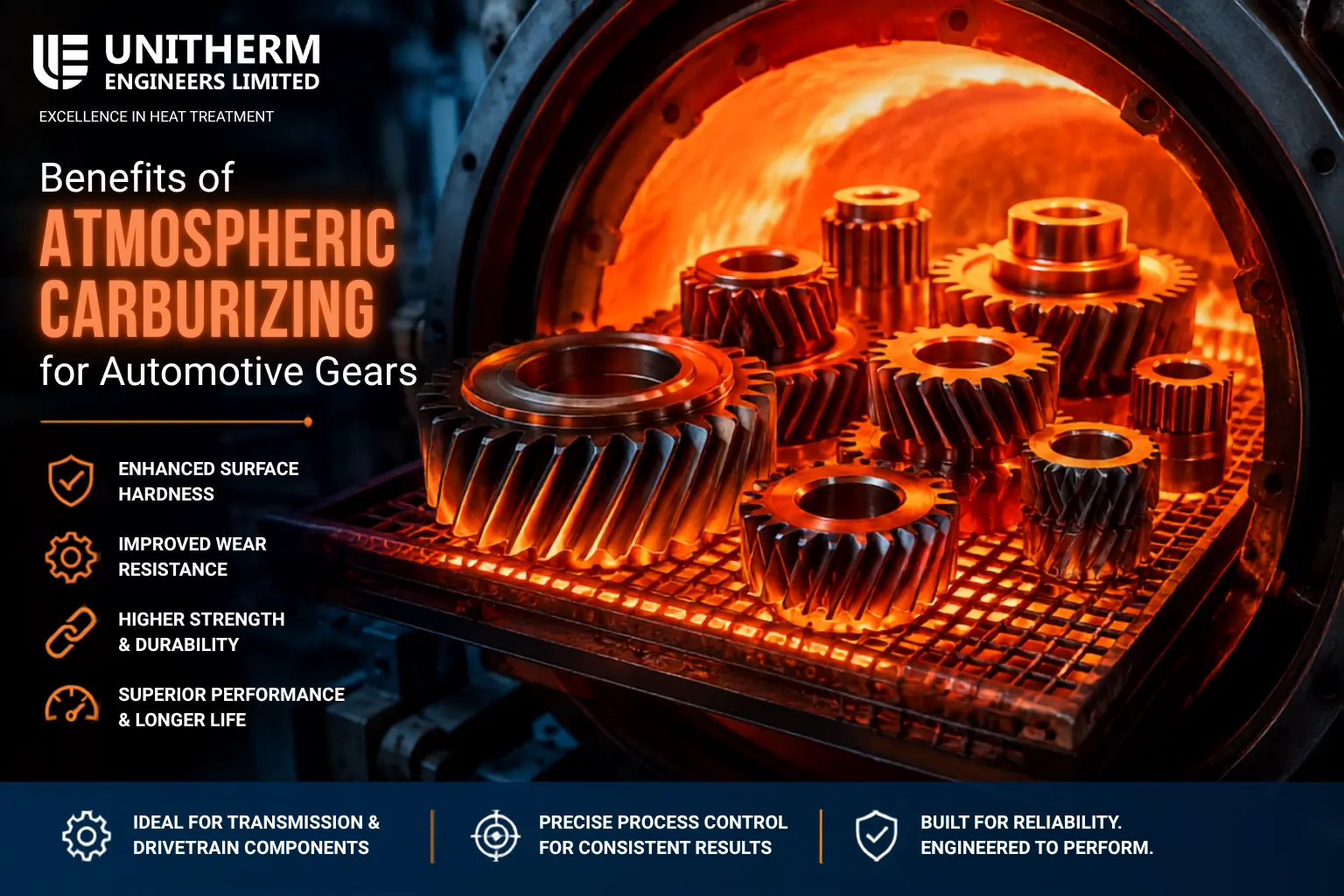
Atmospheric carburizing is one of the most widely used surface hardening processes in the automotive industry. By diffusing carbon into the surface layer of steel within a controlled atmosphere furnace, manufacturers can create a hard, wear-resistant outer case while maintaining a tough and ductile core. The result is a gear component capable of handling demanding operational environments without premature failure.
What is Atmospheric Carburizing?

Atmospheric carburizing is a surface hardening process performed under Atmospheric Heat Treatment conditions using controlled gaseous environments such as endothermic gas enriched with hydrocarbons.
During the process:
  • Steel components are heated to austenitizing temperatures (typically 850–950°C).
  • Carbon-rich gases are introduced into the furnace.
  • Carbon diffuses into the surface of the steel.
  • Components are quenched to form a hard martensitic case.
  • Tempering is performed to improve toughness.
The process creates a hardened surface layer known as the "case," while the inner core remains relatively softer and tougher. This balance is essential for automotive gears that must resist surface wear while absorbing shock loads.

Why Automotive Gears Require Surface Hardening

Gears are subjected to:
  • Continuous rolling and sliding contact
  • High contact stresses
  • Cyclic bending loads
  • Friction-induced wear
  • Pitting and micro-crack formation
Without proper surface hardening , gear teeth can experience premature wear, surface fatigue, and eventual failure. Atmospheric carburizing strengthens the surface without compromising core toughness, making it ideal for automotive gear manufacturing.

Key Benefits of Atmospheric Carburizing for Automotive Gears

1.Improved Surface Hardness and Wear Resistance

The carburized layer transforms into martensite during quenching, producing a hard outer shell. This hardened case significantly enhances resistance to abrasive wear and surface deformation.
For automotive gears, this translates to:
  • Reduced tooth wear
  • Improved resistance to pitting
  • Extended service life

2.Enhanced Fatigue Strength

Carburizing introduces compressive residual stresses into the gear surface. These stresses help resist crack initiation and propagation under cyclic loading conditions.
In high-performance gear systems, improved fatigue resistance reduces the risk of tooth breakage and increases reliability.

3.Tough and Shock-Resistant Core

One of the major advantages of Atmospheric Heat Treatment is the ability to maintain a softer core beneath the hardened case. This core structure absorbs impact loads and prevents brittle fracture.
Automotive gears benefit from:
  • High load-bearing capacity
  • Resistance to sudden torque spikes
  • Improved structural integrity

4.Controlled Case Depth

Atmospheric carburizing allows precise control over case depth through carbon potential monitoring and time-temperature adjustments. Manufacturers can tailor the hardened layer thickness based on gear size and load requirements.
Controlled case depth ensures:
  • Uniform hardness profile
  • Optimal balance between strength and toughness
  • Reduced risk of over-hardening

5.Cost-Effective for High-Volume Production

Automotive manufacturing requires scalable and repeatable processes. Atmospheric carburizing is compatible with:
  • Sealed quench furnaces
  • Continuous belt furnaces
  • Batch processing systems
Compared to alternative hardening techniques, Atmospheric Heat Treatment offers a cost-effective solution for mass production without sacrificing quality.

6.Consistency and Process Reliability

Modern controlled atmosphere furnaces use automated systems to regulate:
  • Carbon potential
  • Temperature uniformity
  • Gas composition
  • Soaking time
This ensures consistent metallurgical properties across large production batches. Reduced variability means lower rejection rates and better overall product reliability.

Role of Controlled Atmosphere in Gear Performance

The success of carburizing depends heavily on atmosphere control. Improper gas composition can lead to:
  • Surface oxidation
  • Decarburization
  • Uneven carbon diffusion
By carefully regulating the furnace atmosphere, manufacturers achieve uniform case formation and prevent surface defects. Controlled atmospheres also minimize scaling, reducing the need for post-treatment machining.
In automotive gear production, even minor surface inconsistencies can affect noise levels, efficiency, and durability. Atmospheric Heat Treatment ensures repeatable and predictable results.

Quality Control in Automotive Gear Carburizing

To ensure optimal performance, manufacturers conduct several tests after carburizing:
  • Hardness Testing (Rockwell scale)– Confirms surface hardness levels
  • Case Depth Measurement– Verifies carbon penetration depth
  • Microstructure Analysis– Examines martensitic formation
  • Dimensional Inspection – Detects distortion
  • Surface Integrity Evaluation – Ensures absence of cracks or soft spots
Proper distortion control practices, including optimized fixturing and controlled cooling, further enhance dimensional stability.

Atmospheric Carburizing vs Other Hardening Methods

1.Induction Hardening

  • Localized heating
  • Faster processing
  • Limited case depth
  • No quenching required
  • Shallower hardened layer
  • Suitable for specific applications

3.Vacuum Carburizing

  • Superior surface finish
  • Higher operational cost

For high-volume automotive gears, Atmospheric Heat Treatment remains the preferred solution due to its balance between performance, scalability, and cost efficiency.

Common Challenges and Solutions

1.Distortion During Quenching

Solution: Optimized fixturing and controlled cooling rates.

2.Inconsistent Carbon Penetration

Solution: Proper carbon potential monitoring and uniform gas circulation.

3.Over-Carburization

Solution: Precise time-temperature control and real-time atmosphere analysis.
With advanced process optimization techniques, these challenges can be effectively managed to ensure reliable gear performance.

Why Automotive Manufacturers Prefer Atmospheric Heat Treatment

The automotive sector demands:
  • High reliability
  • Large-scale production capability
  • Cost efficiency
  • Repeatable metallurgical performance
Atmospheric carburizing meets all these requirements. Its proven industrial track record, compatibility with continuous production lines, and adaptability across steel grades make it a trusted process for gear manufacturing.
As vehicle technology evolves — including electric vehicles and high-efficiency drivetrains — the need for durable, precision-engineered gears continues to grow. Atmospheric Heat Treatment provides the metallurgical foundation for achieving these performance standards.

Conclusion

Atmospheric carburizing remains a cornerstone process within Atmospheric Heat Treatment for automotive gears. By combining surface hardness with core toughness, it enhances wear resistance, fatigue strength, and overall durability. Its scalability and cost-effectiveness make it ideal for high-volume automotive manufacturing.
When properly controlled and optimized, atmospheric carburizing ensures consistent quality, reduced rejection rates, and extended gear life — delivering long-term value to manufacturers and end-users alike.

FAQs

1.What is atmospheric carburizing in automotive gear manufacturing?

Atmospheric carburizing is a surface hardening process performed under Atmospheric Heat Treatment conditions where carbon is diffused into the surface of steel gears inside a controlled atmosphere furnace. This creates a hard outer case while maintaining a tough core for improved durability.

2.Why is atmospheric carburizing preferred for automotive gears?

Automotive gears require high surface hardness and strong fatigue resistance. Atmospheric carburizing provides a hardened wear-resistant layer while preserving core toughness, making it ideal for high-load and high-speed gear applications.

3.What is case depth in carburized gears?

Case depth refers to the thickness of the hardened surface layer formed during carburizing. It is controlled by adjusting temperature, time, and carbon potential within the furnace and is critical for achieving optimal strength and wear resistance.

4.What quality checks are performed after carburizing gears?

Common quality checks include hardness testing (Rockwell scale), case depth measurement, microstructure analysis, dimensional inspection, and surface integrity evaluation to ensure consistent performance and reliability.