Choosing the right heat treatment process is critical for achieving the desired balance between performance, cost, and production efficiency. Among the most widely used technologies today are
Atmospheric Heat Treatment and vacuum heat treatment. While both methods enhance mechanical properties such as hardness, strength, and wear resistance, they differ significantly in operational cost, scalability, surface quality, and application suitability.
Manufacturers often face the question: Should we invest in Atmospheric Heat Treatment or Vacuum Heat Treatment? The answer depends on production volume, component precision, material grade, and budget constraints. This article provides a detailed cost and performance comparison to help decision-makers select the right solution.
1.What is Atmospheric Heat Treatment?
Atmospheric Heat Treatment is performed in controlled gaseous environments inside sealed furnaces. Instead of exposing components to open air, specially formulated gases such as endothermic gas, nitrogen blends, or carbon-enriched atmospheres are introduced to regulate oxidation and carbon potential.
This process is commonly used for:
- Carburizing
- Carbonitriding
- Hardening and tempering
- Annealing
- Stress relieving
Atmospheric systems are widely adopted in
automotive and heavy engineering industries due to their scalability and cost efficiency. Continuous furnaces and sealed quench systems allow large production batches with consistent metallurgical results.
What Is Vacuum Heat Treatment?
Vacuum heat treatment is carried out in a sealed chamber from which air is removed to create a low-pressure environment. Heating occurs in near-oxygen-free conditions, preventing oxidation without the need for reactive gases.
Key characteristics include:
- Minimal surface oxidation
- Superior surface cleanliness
- Gas quenching or high-pressure quenching
- Reduced risk of decarburization
Vacuum processes are particularly suited for high-alloy steels, aerospace components, and precision tooling where surface finish and dimensional stability are critical.
Cost Comparison: Atmospheric vs Vacuum
1.Equipment Investment
Atmospheric Heat Treatment systems generally have lower initial capital costs compared to vacuum furnaces. While sealed quench furnaces and continuous systems require infrastructure for gas handling, their overall investment is typically lower than advanced vacuum systems.
Vacuum furnaces involve:
- High-strength pressure vessels
- Advanced pumping systems
- Sophisticated temperature controls
- High-pressure gas quenching systems
These features significantly increase upfront investment costs.
Winner (Initial Cost): Atmospheric Heat Treatment
2.Operational Costs
Operational cost depends on energy consumption, gas usage, maintenance, and cycle time.
Atmospheric systems require continuous gas supply and carbon potential monitoring, but they are optimized for high-volume production. The cost per part decreases significantly when processing large batches.
Vacuum systems consume more electrical energy due to heating elements and vacuum pumps. While they reduce gas consumption, maintenance and equipment servicing costs are typically higher.
Winner (High Volume Production): Atmospheric Heat Treatment
Winner (Premium Low Volume Precision): Vacuum
3.Production Scalability
Atmospheric furnaces are well-suited for:
- Continuous production lines
- Large automotive batches
- Mass production of gears, shafts, and forgings
Vacuum systems are usually batch-based and better suited for smaller production volumes requiring strict process control.
Winner (Scalability): Atmospheric Heat Treatment
Performance Comparison
Surface Finish
Vacuum heat treatment offers superior surface cleanliness because there is virtually no oxygen present. This results in:
- Bright surface finish
- Minimal scale formation
- Reduced post-processing
Modern
Atmospheric Heat Treatment systems, however, use
controlled atmosphere gases to significantly reduce oxidation. While minor discoloration may occur in some cases, proper gas management minimizes surface defects.
Winner (Surface Finish): Vacuum
Distortion Control
Vacuum heat treatment often uses uniform heating and controlled gas quenching, reducing thermal gradients and distortion.
Atmospheric processes can also achieve distortion control through:
- Optimized fixturing
- Controlled cooling rates
- Uniform temperature distribution
For extremely tight tolerances, vacuum systems may offer a slight advantage.
Winner (Minimal Distortion): Vacuum
Case Depth Control
In
carburizing applications, Atmospheric Heat Treatment allows precise carbon potential control for tailored case depth. It is especially effective for deep case hardening in automotive gears.
Vacuum carburizing offers very clean and controlled carbon diffusion but at higher operational cost.
Both systems provide excellent case control when properly managed.
Winner (Cost-Effective Case Depth Control): Atmospheric Heat Treatment
Mechanical Properties
Both technologies can achieve:
- High hardness levels
- Strong fatigue resistance
- Controlled microstructure transformation
The final mechanical properties largely depend on process parameters rather than furnace type. When optimized, both systems deliver comparable strength and wear resistance.
Winner (Mechanical Performance): Comparable
Application Suitability
Best Applications for Atmospheric Heat Treatment
- Automotive gears
- Shafts and sprockets
- Forged components
- Mass-produced mechanical parts
- Cost-sensitive projects
Atmospheric systems dominate industries where volume and efficiency are critical.
Best Applications for Vacuum Heat Treatment
- Aerospace components
- High alloy steels
- Medical instruments
- Precision tooling
- Parts requiring minimal oxidation
Vacuum systems are preferred where surface perfection and dimensional accuracy are non-negotiable.
Advantages & Limitations Summary
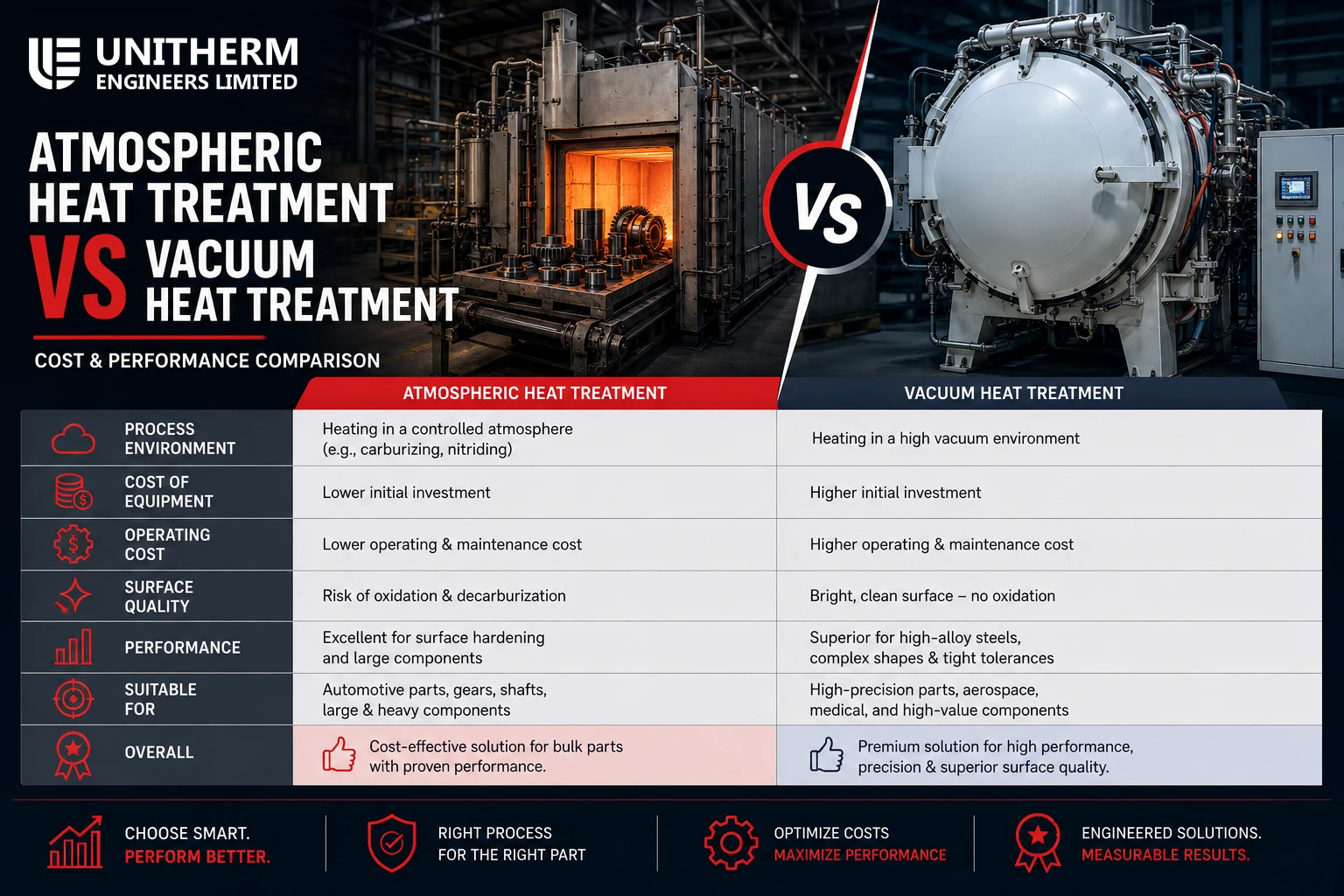
| Factor |
Atmospheric Heat Treatment |
Vacuum Heat Treatment |
| Initial Investment |
Lower |
Higher |
| Operating Cost |
Moderate |
Higher |
| Surface Finish |
Good (Controlled) |
Excellent |
| Distortion Control |
Controlled |
Minimal |
| Scalability |
Excellent |
Moderate |
| Ideal For |
Mass Production |
Precision Components |
Which Process Should You Choose?
The decision between Atmospheric Heat Treatment and vacuum heat treatment depends on several factors:
- Production volume
- Budget constraints
- Required surface finish
- Component complexity
- Steel grade
- Tolerance requirements
If your priority is cost efficiency and high-volume output,
Atmospheric Heat Treatment is typically the better option. If precision, ultra-clean surfaces, and minimal distortion are critical, vacuum heat treatment may justify the higher investment.
In many industrial settings, manufacturers use both technologies for different product lines based on application demands.
Conclusion
Both Atmospheric Heat Treatment and vacuum heat treatment offer distinct advantages. Atmospheric systems provide cost-effective scalability and reliable performance for mass production, making them the backbone of automotive and heavy engineering industries. Vacuum systems deliver superior surface quality and dimensional precision for high-value, low-volume components.
Ultimately, the right choice depends on balancing cost, performance expectations, and production goals. A technical evaluation of material grade, case depth requirement, and tolerance limits is essential before finalizing the process.
When selected and optimized correctly, either technology can deliver excellent metallurgical results — but understanding their differences ensures smarter investment and better long-term returns.
Frequently Asked Questions
What is the main difference between Atmospheric Heat Treatment and vacuum heat treatment?
The main difference is the furnace environment. Atmospheric Heat Treatment uses controlled gases to regulate oxidation and carbon potential, while vacuum heat treatment removes air entirely, creating a low-pressure oxygen-free chamber for cleaner processing.
Which process provides better surface finish?
Vacuum heat treatment generally provides a cleaner and brighter surface finish because there is virtually no oxygen present. However, modern Atmospheric Heat Treatment systems with proper atmosphere control can significantly minimize oxidation and scaling.
Which heat treatment process is better for automotive gears?
Atmospheric Heat Treatment is commonly preferred for automotive gears because it supports high-volume production, precise case depth control, and cost-effective carburizing processes.
Which process has higher operational costs?
Vacuum heat treatment generally has higher operational and maintenance costs due to vacuum pumps, advanced controls, and energy consumption. Atmospheric Heat Treatment typically offers lower per-part cost in large-scale production.