Surface hardening is one of the most widely used heat treatment techniques for improving the durability, wear resistance, and fatigue strength of steel components. Among the various
case hardening methods available today,
carburizing and
carbonitriding are two of the most commonly used processes in the automotive, tooling, and industrial manufacturing sectors.
When evaluating
Carburizing vs
Carbonitriding, manufacturers often seek the best balance between
surface hardness, case depth, production cost, and component performance. Although both processes enrich the surface of steel to create a hardened case while maintaining a tough core, they differ significantly in their processing parameters, microstructure development, and application suitability.
This article explores the key differences between carburizing and carbonitriding to help engineers and manufacturers select the most effective
surface hardening solution.
What is Carburizing?
Carburizing is a thermochemical
heat treatment process that introduces carbon into the surface layer of low-carbon steel. The process is typically performed in a
controlled atmosphere furnace at temperatures ranging from
900°C to 950°C.
During carburizing, carbon-rich gases surround the component, allowing carbon atoms to diffuse into the steel surface. After achieving the required case depth, the component is quenched to form a hard
martensitic surface while retaining a tough and ductile core.
Benefits of Carburizing
-
Deep case depth
-
Excellent wear resistance
-
Improved fatigue strength
-
Enhanced load-bearing capacity
-
Long service life
Typical Applications
-
Automotive transmission gears
-
Shafts
-
Bearings
-
Industrial machinery components
-
Heavy-duty powertrain parts
Carburizing is particularly suitable for components subjected to high cyclic loads and severe wear conditions.
What is Carbonitriding?
Carbonitriding is a modified
case hardening process that introduces both
carbon and nitrogen into the steel surface. The process is generally performed at lower temperatures, typically between
750°C and 900°C, in a
controlled atmosphere furnace containing carbon-rich gases and ammonia.
The addition of nitrogen increases surface hardness and improves hardenability. Because nitrogen diffuses more slowly than carbon, carbonitriding generally produces a shallower case depth than carburizing but achieves excellent surface wear resistance.
Benefits of Carbonitriding
- Higher surface hardness
- Improved wear resistance
- Enhanced hardenability
- Reduced distortion
- Faster processing cycles
Typical Applications
- Fasteners
- Small gears
- Bushings
- Stampings
- Automotive components
If carbon potential is too high:
- Carbide networks may form
- Surface brittleness increases
- Soot deposition can occur inside the furnace
Carbonitriding is widely used for high-volume production where cost efficiency and shorter cycle times are important.
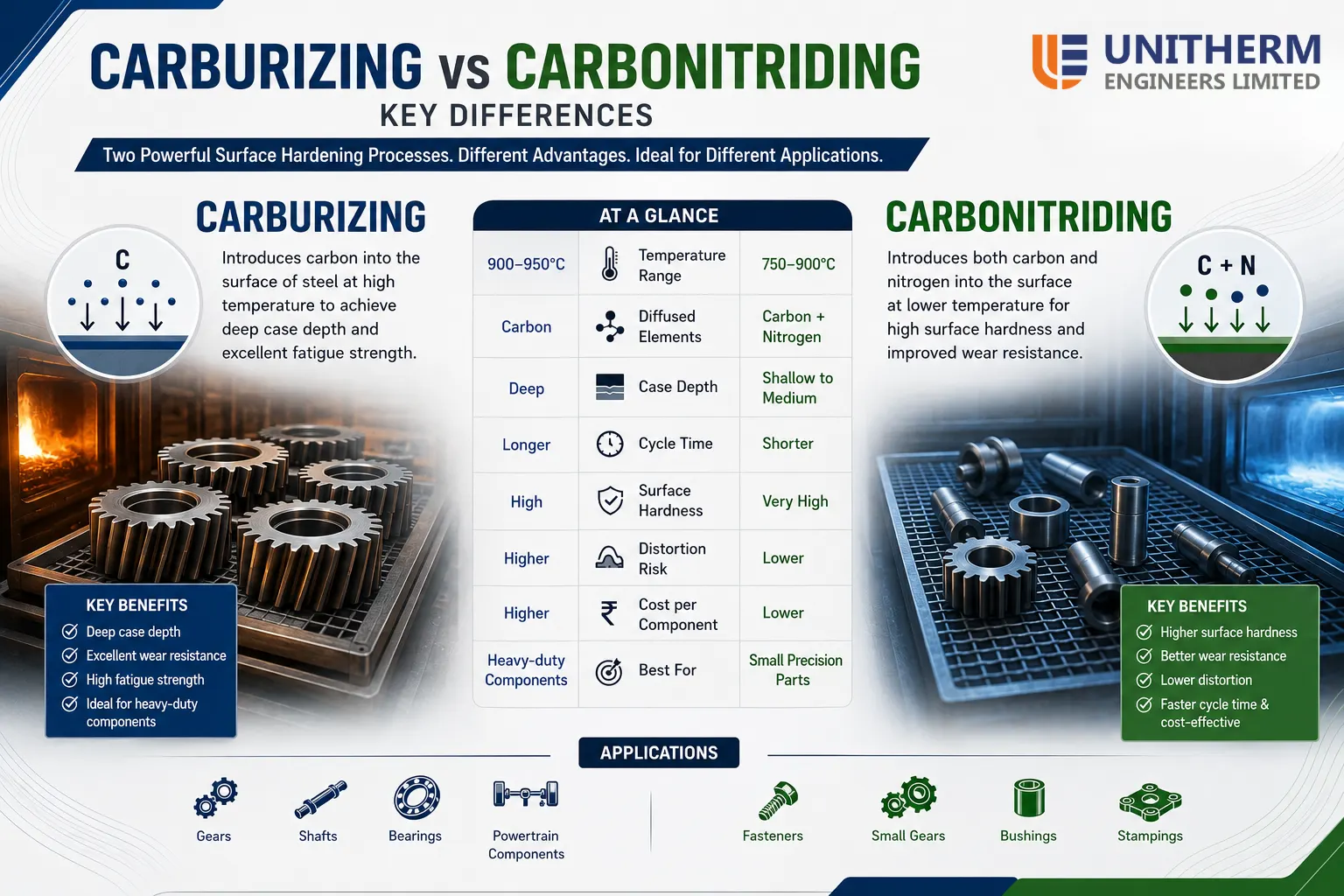
Carburizing vs Carbonitriding: Process Comparison
Although both processes are designed to improve surface properties, they differ in several key aspects.
| Parameter |
Carburizing |
Carbonitriding |
| Diffused Elements |
Carbon |
Carbon + Nitrogen |
| Temperature Range |
900–950°C |
750–900°C |
| Case Depth |
Deep |
Shallow to Medium |
| Cycle Time |
Longer |
Shorter |
| Surface Hardness |
High |
Very High |
| Distortion Risk |
Higher |
Lower |
| Cost Per Component |
Higher |
Lower |
| Best For |
Heavy-duty components |
Small precision parts |
The choice between the two processes depends largely on component size, required case depth, and production requirements.
Microstructure Differences
The microstructure developed during
heat treatment plays a major role in determining component performance.
Carburized Components
After quenching, carburized components typically develop:
- High-carbon martensite
- Retained austenite
- Fine carbide particles
- Deep hardness profile
This microstructure provides exceptional fatigue strength and load-bearing capacity, making carburizing ideal for gears and shafts operating under heavy loads.
Carbonitrided Components
Carbonitrided parts typically exhibit:
- Fine martensitic structure
- Nitride-enhanced surface layer
- Increased surface hardness
- Improved wear resistance
The presence of nitrogen refines the microstructure and contributes to better resistance against adhesive wear and surface fatigue.
Performance Comparison
Wear Resistance
Both processes significantly improve wear resistance. However, carbonitriding often produces a
harder surface due to nitrogen enrichment, which can provide additional protection against abrasive wear.
Fatigue Strength
Carburizing generally offers superior fatigue strength because of its deeper hardened case. This makes it particularly effective for gears and power transmission components.
Distortion Control
Since
carbonitriding operates at lower temperatures, it generally results in less distortion than carburizing. This is beneficial for precision parts with tight dimensional tolerances.
Corrosion Resistance
The nitrogen introduced during carbonitriding can provide a slight improvement in corrosion resistance compared to traditional carburizing.
Cost Comparison
Cost is often a critical factor when choosing between carburizing and carbonitriding.
Carburizing
Carburizing requires:
- Higher processing temperatures
- Longer furnace cycles
- Greater energy consumption
- More extensive process control
These factors increase the overall processing cost.
Carbonitriding
Carbonitriding offers:
- Faster cycle times
- Lower operating temperatures
- Higher production throughput
- Reduced energy consumption
As a result, carbonitriding is often the more economical option for high-volume manufacturing.
Industry Applications
Applications Best Suited for Carburizing
Applications Best Suited for Carbonitriding
- Fasteners
- Small automotive parts
- Stampings
- Precision components
- Bushings and pins
The application environment and performance requirements ultimately determine the preferred process.
How to Choose Between Carburizing and Carbonitriding
When evaluating Carburizing vs Carbonitriding, manufacturers should consider:
- Required case depth
- Surface hardness requirements
- Component size and geometry
- Production volume
- Distortion tolerance
- Budget constraints
Choose carburizing when deep case depth and maximum fatigue strength are critical.
Choose
carbonitriding when higher
surface hardness, reduced distortion, and lower production costs are the primary objectives.
A detailed metallurgical assessment can help determine the most suitable process for a specific application.
Common Challenges and Best Practices
Carburizing Challenges
- Distortion due to high temperatures
- Excess retained austenite
- Longer processing cycles
Carbonitriding Challenges
- Limited case depth
- Process consistency requirements
- Nitrogen control management
Best Practices
- Maintain proper atmosphere control
- Monitor carbon potential continuously
- Calibrate furnace sensors regularly
- Conduct hardness and microstructure testing
- Optimize quenching parameters
These practices ensure consistent quality and reliable component performance.
Conclusion
The comparison of Carburizing vs Carbonitriding highlights that both processes are highly effective surface hardening methods, each offering unique advantages.
Carburizing is ideal for applications requiring deep case depth, exceptional fatigue strength, and long-term durability under heavy loads. Carbonitriding, on the other hand, provides higher surface hardness, lower distortion, faster processing times, and greater cost efficiency for high-volume production.
Selecting the right process depends on component requirements, operating conditions, and production objectives. By understanding the differences between carburizing and carbonitriding, manufacturers can make informed decisions that improve performance, reliability, and overall product life.
FAQs-Carburizing vs Carbonitriding: Key Differences
1.What is the main difference between carburizing and carbonitriding?
The primary difference is the elements introduced into the steel surface. Carburizing adds carbon, while carbonitriding introduces both carbon and nitrogen. This results in different case depths, hardness levels, and performance characteristics.
2.Which process produces a deeper case depth: carburizing or carbonitriding?
Carburizing typically produces a deeper hardened case because carbon diffuses further into the steel at higher processing temperatures. Carbonitriding generally creates a shallower case but achieves excellent surface hardness.
3. Is carbonitriding harder than carburizing?
Yes, carbonitriding often produces higher surface hardness due to the addition of nitrogen, which enhances hardenability and wear resistance. However, carburizing usually provides better fatigue strength because of its deeper case depth.
4. When should carburizing be used instead of carbonitriding?
Carburizing is preferred for heavy-duty components that require deep case depth, high fatigue strength, and excellent load-bearing capability, such as gears, shafts, bearings, and industrial machinery parts.
5. What industries commonly use carbonitriding?
Carbonitriding is widely used in automotive, fastener, stamping, and precision engineering industries. It is particularly suitable for small components requiring high surface hardness and cost-effective mass production.
6.Does carbonitriding cause less distortion than carburizing?
Yes. Since carbonitriding is typically performed at lower temperatures, it generally results in less distortion and better dimensional stability compared to carburizing, making it ideal for precision components.