Blog

Difference Between Carbonitriding & Nitrocarburizing Process: A Complete Comparison

Difference Between Carbonitriding & Nitrocarburizing Process
In modern manufacturing, enhancing the durability, strength, and wear resistance of metal components is essential for maintaining performance and reliability. Surface hardening methods play a crucial role in achieving these goals, and among the most widely used techniques are the carbonitriding and nitrocarburizing processes. While both belong to the heat treatment process category, they differ significantly in temperature, results, applications, and performance outcomes. Understanding these differences helps industries choose the most suitable method when opting for heat treating services or searching for nitriding process near me for specialized components.
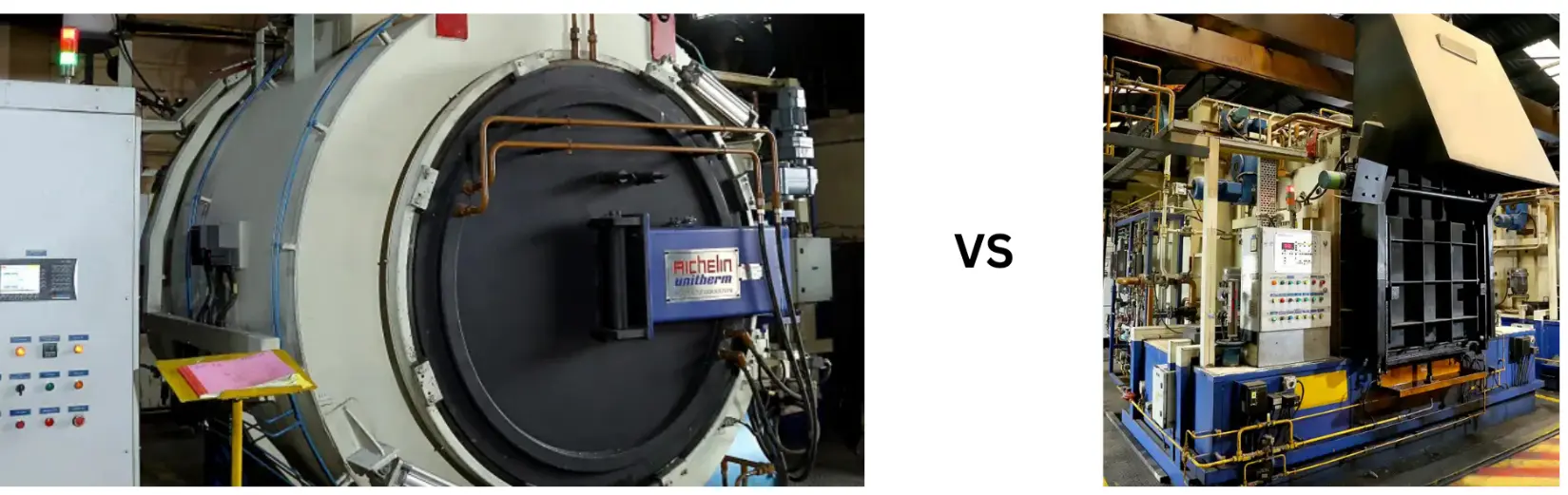
What Is Carbonitriding?

Carbonitriding is a high-temperature heat treatment process designed to improve the hardness and wear resistance of steel components. This technique involves the diffusion of carbon and nitrogen into the metal surface at temperatures typically between 850°C and 880°C. Because of the high temperature, the process allows for deeper case depths, making the components stronger and more resilient.
This method is especially useful for low-carbon and mild steels, which require an enhanced surface layer to withstand friction and stress. Industries seeking heat treating services near me often choose carbonitriding for components such as gears, shafts, fasteners, and other mechanical parts exposed to high-impact operations.

Benefits of Carbonitriding

  • High surface hardness
  • Improved wear resistance
  • Deeper case depths
  • Cost-effective for bulk processing
  • Suitable for automotive, machinery, and heavy-duty applications

What Is Nitrocarburizing?

The nitrocarburizing process is a low-temperature heat treatment method that primarily enriches the steel surface with nitrogen, with a smaller amount of carbon. This process is typically performed between 500°C and 580°C, which makes it more controlled and minimizes the risk of part distortion.
There are several types of nitrocarburizing, including gas nitrocarburizing, salt bath nitrocarburizing, and plasma nitrocarburizing. All variations result in improved fatigue strength, excellent wear resistance, and enhanced corrosion protection. This makes it ideal for precision parts that require dimensional stability. Industries that require specialized finishing often search for services like nitriding process near me to meet quality standards.

Benefits of Nitrocarburizing

  • Superior corrosion resistance
  • Minimal distortion due to low processing temperatures
  • Improved fatigue strength
  • Better wear resistance in sliding or continuous-contact applications
  • Used for automotive, aerospace, hydraulic, and defense components

Key Differences Between Carbonitriding & Nitrocarburizing

While both processes improve surface characteristics, the differences between them are crucial for choosing the right method.

1. Processing Temperature

  • Carbonitriding: High temperature (850–880°C)
  • Nitrocarburizing: Lower temperature (500–580°C)
The high temperature of carbonitriding allows deeper penetration of carbon and nitrogen, while the lower temperature of nitrocarburizing helps maintain dimensional stability.

2. Case Depth

  • Carbonitriding: Deeper case depth up to 0.75 mm
  • Nitrocarburizing: Shallow case depth
Carbonitriding is more suitable for parts requiring a deep hardened layer, whereas nitrocarburizing is ideal for precision components.

3. Hardness & Wear Resistance

  • Carbonitriding: Very high surface hardness
  • Nitrocarburizing: Moderate hardness but better wear resistance under sliding conditions

4. Corrosion Resistance

  • Nitrocarburizing: offers significantly better corrosion protection due to the formation of a compound layer.
  • Carbonitriding requires additional coatings for corrosion resistance.

5. Component Distortion

  • Carbonitriding: Higher chances of distortion due to elevated temperature
  • Nitrocarburizing: Minimal distortion, suitable for precision parts

Applications of Each Process

Carbonitriding Applications

  • Automotive gears
  • Shafts & axles
  • Fasteners
  • Tools & hardware
  • Heavy-duty machinery components

Nitrocarburizing Applications

  • Hydraulic cylinders
  • Pistons & pins
  • Transmission components
  • Defense and aerospace parts
  • Precision-engineered components

Which Process Should You Choose?

Selecting between carbonitriding and nitrocarburizing depends on several factors, including:
  • Required case depth
  • Component material
  • Operational environment (corrosion, stress, friction)
  • Dimensional tolerance requirements
  • Budget and production volume
Industries that rely on heat treating services can benefit from expert guidance to ensure optimal results. When searching for heat treating services near me, companies should consider the type of parts they manufacture, performance expectations, and operating environments before selecting a process.

Importance of Pre-Cleaning Before Both Processes

Surface preparation plays a significant role in the success of any heat treatment process. Ultrasonic cleaning ensures that contaminants, oils, and debris are completely removed. Clean surfaces allow deeper and more uniform diffusion of nitrogen and carbon, resulting in consistent hardening and better-quality results.
This step is especially critical for those relying on nitriding process near me, where precision and uniformity are key requirements.
Conclusion
Both carbonitriding and nitrocarburizing offer excellent benefits for improving the durability and performance of steel components. Carbonitriding focuses on deep hardening and high impact strength, while nitrocarburizing emphasizes corrosion resistance, dimensional stability, and wear protection. Choosing the right process depends on the specific application requirements, and consulting expert heat treating services can help industries achieve the best results.