Blog

Ferritic Nitriding Process (FNC): A Complete Guide to Modern Surface Hardening

- Ferritic Nitriding Process (FNC)
In today’s competitive manufacturing landscape, components must withstand high stress, friction, and continuous operation without failure. To achieve this level of durability, industries rely heavily on advanced surface hardening processes. Among the most efficient and distortion-free methods is the Ferritic Nitriding Process (FNC)—a specialized form of nitriding widely used in automotive, industrial, and engineering sectors.
With growing industry demand, many engineers and manufacturers frequently search for “nitriding process near me” or “heat treat companies near me” to find trusted service providers who can deliver consistent, high-quality results. This blog explores the FNC process in detail, its advantages, applications, and why it has become a preferred choice across various sectors.
What Is the Ferritic Nitriding (FNC) Process?

Ferritic nitriding is a heat treatment method in which nitrogen diffuses into the surface of steel while the metal remains in its ferritic phase. Unlike traditional nitriding processes that operate at higher temperatures, FNC is performed at 500–600°C, a range purposely kept below the steel's transformation temperature.
This ensures that the metal structure remains stable while receiving the benefits of increased hardness and wear resistance. As nitrogen penetrates the surface, it forms hard iron nitrides that significantly enhance the component’s mechanical properties.
Because of its low temperature and controlled atmosphere, FNC is recognized as one of the most dimensionally stable heat treatment processes available today.

How FNC Differs from Traditional Nitriding

While FNC belongs to the nitriding family, it differs in several ways:
  • Lower Process Temperature: Traditional gas or plasma nitriding may operate at slightly higher temperatures, while FNC keeps the metal within the ferritic region, reducing distortion.
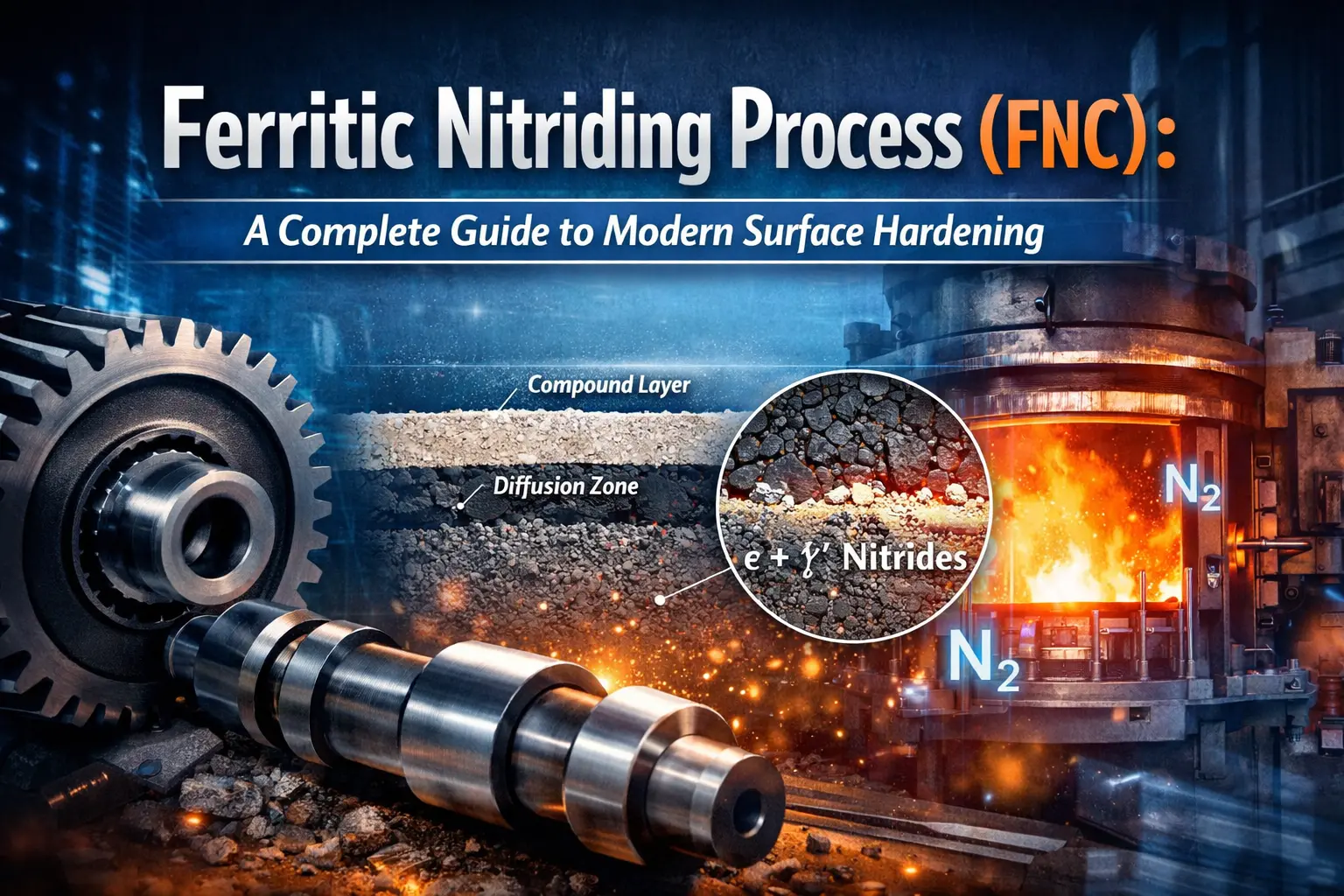
  • Case Structure: FNC forms a compound layer of ε (epsilon) and γ’ (gamma prime) iron nitrides, providing excellent wear resistance.
  • Simplified Chemistry: The process involves nitrogen diffusion without additional carbon enrichment.
  • Minimal Warping: Its low temperature ensures excellent dimensional control, making FNC ideal for precision parts.
These distinctions make FNC a preferred choice when dimensional accuracy and wear resistance are equally critical. .

Surface Hardening Mechanism of FNC

During the FNC process, nitrogen-rich gases are introduced into the controlled furnace environment. Nitrogen atoms diffuse into the steel surface, creating:
  1. Compound Layer : A hard, wear-resistant outer layer of iron nitrides.
  2. Diffusion Zone: A deeper layer where nitrogen enhances fatigue strength and improves durability.
This dual-layer formation results in:
  • Higher surface hardness
  • Improved wear resistance
  • Enhanced fatigue life
  • Better resistance to fretting and galling
Because these enhancements occur without significantly altering the internal structure, FNC is considered extremely reliable for high-precision engineering applications.

Benefits of the Ferritic Nitriding Process

The FNC process offers a wide range of advantages, making it a top choice among industries seeking dependable heat treating services :
  1. Minimal Distortion:
    Low processing temperature ensures the part retains its original shape and dimensions.

  2. High Wear Resistance:
    Iron nitrides formed during FNC provide excellent resistance against frictional forces.

  3. Improved Fatigue Strength:
    The diffusion zone strengthens the component against continuous cyclic loads.

  4. Excellent Corrosion Resistance:
    FNC significantly enhances corrosion resistance compared to untreated steel.

  5. Reduced Coefficient of Friction:
    Improved surface finish ensures smoother operation and reduced energy loss.

  6. Cost-Effective
    Lower energy usage and minimal post-processing make FNC an economical choice.

  7. Environment-Friendly
    FNC avoids harmful salts and chemicals used in older hardening processes .

Applications of Ferritic Nitriding

FNC is used across industries for components requiring high wear resistance, long service life, and excellent fatigue performance. Common applications include:
  • Automotive: brake rotors, crankshafts, camshafts, piston pins
  • Industrial machinery: pump shafts, gears, spindles
  • Tooling: dies, fixtures, forming tools
  • Defense & firearm components: slides, barrels, and bolts
  • General engineering: components subject to heavy load cycles
Manufacturers searching for “heat treating services near me” often choose FNC because it provides a balance of performance, cost, and dimensional control.

Materials Suitable for FNC

FNC works well with:
  • Low-alloy steels
  • Carbon steels
  • Tool steels
  • Certain stainless steels (with modified processes)
Material composition plays a major role in nitrogen absorption, and the final hardness achieved depends on alloying elements such as chromium, molybdenum, and aluminum.

Importance of Pre-Cleaning in FNC

Surface preparation is essential to ensure uniform nitrogen diffusion. Processes such as:
  • Degreasing
  • Shot cleaning
  • Ultrasonic cleaning
remove contaminants that may interfere with nitrogen absorption. Clean surfaces result in a more uniform compound layer and superior functional performance.

FNC vs Other Surface Hardening Processes

Compared to carbonitriding, carburizing, or plasma nitriding, FNC offers:
  • Less distortion
  • Better corrosion resistance
  • Lower processing cost
  • More stable hardness
  • Greater suitability for precision parts
This makes it ideal for industries prioritizing accuracy and consistent quality.

Conclusion

The Ferritic Nitriding Process (FNC) stands out as one of the most reliable and advanced surface hardening processes in modern engineering. Its ability to enhance wear resistance, fatigue strength, and corrosion performance—while keeping distortion extremely low—makes it a preferred choice across industries.
For manufacturers looking to improve component longevity and performance, opting for professional heat treating services or trusted heat treat companies near me ensures precision results every time.