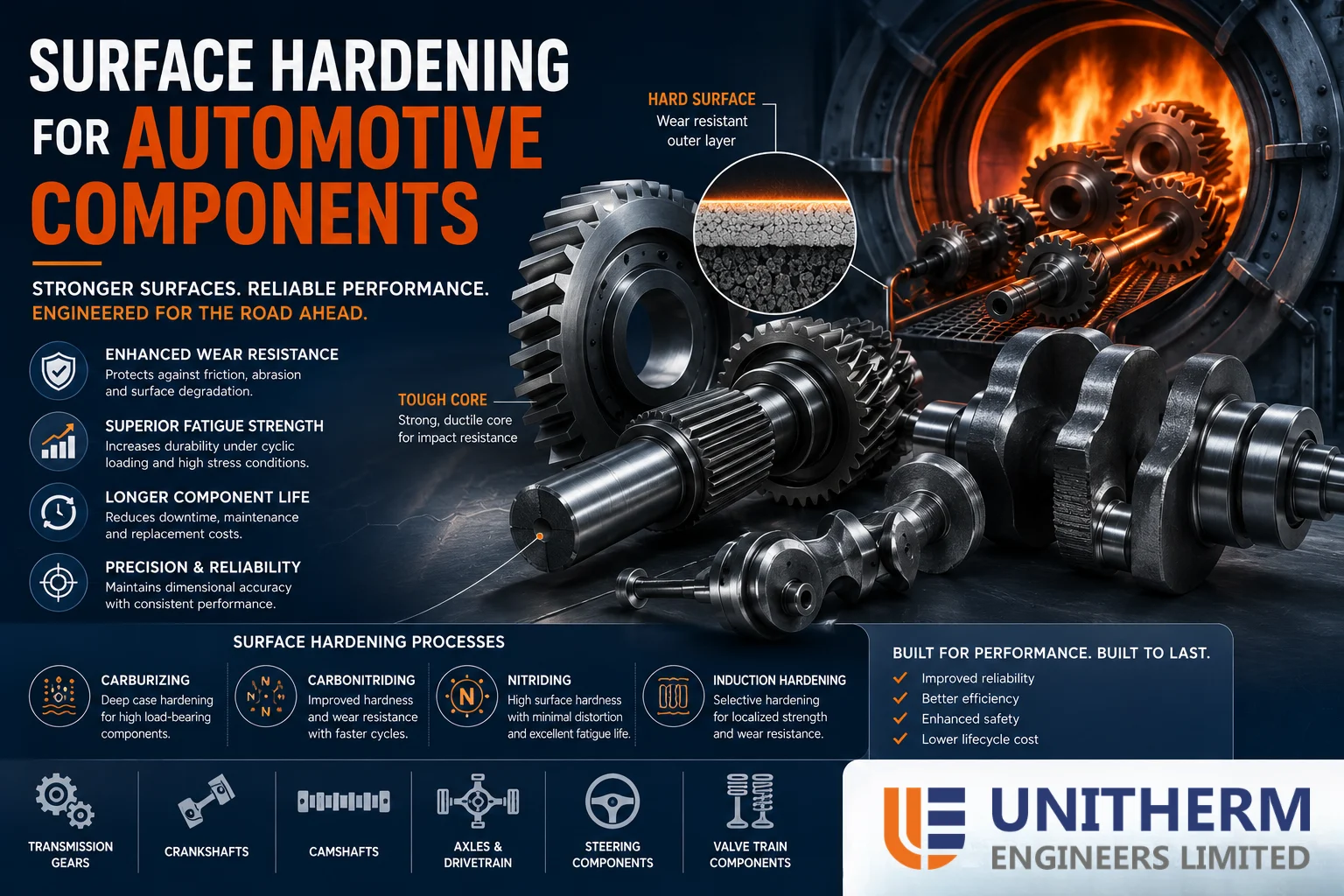
The automotive industry continuously pushes the boundaries of performance, efficiency, and durability. Modern vehicles operate under demanding conditions where components are subjected to high loads, friction, repetitive motion, and extreme contact stresses. As a result, manufacturers must ensure that critical
automotive parts deliver long service life while maintaining reliability and safety.
One of the most effective ways to achieve this is through
Surface Hardening. This specialized
heat treatment process improves the hardness of a component's outer layer while preserving the toughness and strength of its core. By enhancing
wear resistance , fatigue strength, and load-bearing capacity,
surface hardening plays a crucial role in the performance of gears, shafts, crankshafts, camshafts, and numerous other automotive components.
As vehicle manufacturers strive for higher efficiency and longer-lasting components, Surface Hardening has become an essential part of
modern automotive manufacturing.
What is Surface Hardening?
Surface Hardening is a heat treatment process
designed to increase the hardness of a component's surface without significantly affecting its core properties. The goal is to create a wear-resistant outer layer while maintaining a tough and ductile interior.
Unlike through hardening, where hardness is achieved throughout the entire component, surface hardening focuses only on the surface region that experiences wear and contact stress.
This combination provides several advantages:
-
Improved wear resistance
-
Enhanced fatigue strength
-
Better impact resistance
- Increased load-carrying capability
- Longer component life
For
automotive applications, this balance between hardness and toughness is critical for ensuring reliable performance under demanding operating conditions.
Why Surface Hardening is Important for Automotive Components
Automotive components face numerous challenges during operation.
Friction and Abrasion
Continuous contact between moving parts generates friction, leading to material loss and surface degradation over time.
Cyclic Loading
Components such as gears and shafts experience repeated loading cycles that can cause fatigue failure.
Contact Stress
High torque transmission creates significant contact pressures between mating surfaces.
Wear and Fatigue
Without adequate surface protection, automotive components can experience premature wear, pitting, and cracking.
Benefits of Surface Hardening
- Increased wear resistance
- Higher fatigue strength
- Improved durability
- Reduced maintenance requirements
- Enhanced operational reliability
These benefits directly contribute to improved vehicle performance and reduced lifecycle costs.
Common Surface Hardening Processes Used in Automotive Manufacturing
Several
surface hardening methods are widely used across the automotive industry.
Carburizing
Carburizing is a thermochemical process that introduces carbon into the steel surface at elevated temperatures.
Benefits:
- Deep case depth
- Excellent fatigue strength
- Superior wear resistance
Typical Automotive Applications:
- Transmission gears
- Gear shafts
- Differential components
- Powertrain parts
Carburizing is particularly suitable for heavily loaded components requiring deep hardened layers.
Carbonitriding
Carbonitriding introduces both carbon and nitrogen into the surface layer.
Benefits:
- Increased surface hardness
- Improved wear resistance
- Faster processing cycles
Applications:
- Small gears
- Fasteners
- Automotive hardware
- Precision components
Typical Automotive Applications:
- Transmission gears
- Gear shafts
- Differential components
- Powertrain parts
Nitriding
Nitriding diffuses nitrogen into the component surface at relatively low temperatures.
Benefits:
- Minimal distortion
- High surface hardness
- Excellent fatigue resistance
Applications:
- Crankshafts
- Camshafts
- Valve train components
Because nitriding does not require quenching, it is ideal for precision-engineered
automotive parts.
Induction Hardening
Induction hardening uses electromagnetic induction to heat localized areas of a component before rapid cooling.
Benefits:
- Selective hardening
- Fast processing
- Precise hardness control
Applications:
- Axles
- Drive shafts
- Steering components
- Wheel hubs
This process is particularly effective when only specific areas require hardening.
Microstructure Development During Surface Hardening
The performance benefits of
Surface Hardening are largely determined by the microstructure created during the heat treatment process.
Surface Layer Formation
The hardened case typically contains:
- Martensite
- Carbides
- Nitrides
- Hardened diffusion zones
These microstructural features significantly improve resistance to wear and contact fatigue.
Tough Core Structure
Beneath the hardened surface lies a tougher and more ductile core.
The core provides:
- Impact resistance
- Shock absorption
- Structural integrity
This combination of a hard surface and tough core allows automotive components to withstand both wear and mechanical loading.
Automotive Components That Benefit from Surface Hardening
Powertrain Components
Power transmission systems rely heavily on hardened components.
Examples include:
- Transmission gears
- Splined shafts
- Gear hubs
- Synchronizer components
These parts require exceptional wear resistance and fatigue strength.
Engine Components
Power transmission systems rely heavily on hardened components.
Examples include:
- Camshafts
- Crankshafts
- Valve train components
- Timing system parts
Surface hardening helps reduce wear while maintaining dimensional stability.
Drivetrain Components
Drivetrain systems transmit torque throughout the vehicle.
Common hardened parts include:
- Axles
- Differential gears
- Universal joints
- Drive shafts
These components operate under high stress and require enhanced durability.
Steering and Suspension Components
Steering and suspension systems also benefit from surface hardening.
Examples include:
- Steering shafts
- Ball joints
- Pins
- Bushings
Improved surface properties increase reliability and safety.
Surface Hardening and Wear Resistance
Wear resistance is one of the primary reasons manufacturers use surface hardening.
A hardened surface helps resist:
Abrasive Wear
Continuous contact between moving parts generates friction, leading to material loss and surface degradation over time.
Adhesive Wear
Metal-to-metal contact can lead to surface damage and galling. Hardened surfaces minimize these effects.
Surface Fatigue
Repeated contact stresses may cause pitting and spalling. Surface hardening improves resistance to fatigue-related wear.
As a result, automotive components maintain performance over longer service intervals.
Surface Hardening and Fatigue Strength
Fatigue failure is a major concern in
automotive engineering.
Surface hardening improves fatigue strength by:
- Increasing surface hardness
- Introducing compressive residual stresses
- Preventing crack initiation
- Slowing crack propagation
These improvements are especially important for gears, shafts, and drivetrain components subjected to repeated cyclic loading.
Enhanced fatigue resistance directly contributes to vehicle safety and reliability.
Challenges in Automotive Surface Hardening
While highly effective, surface hardening requires precise process control.
Common Challenges
- Distortion during heat treatment
- Surface cracking
- Uneven hardness distribution
- Decarburization
- Excess retained austenite
Solutions
Manufacturers minimize these issues through:
Proper process management ensures consistent component performance.
Emerging Trends in Automotive Surface Hardening
As automotive technology evolves, so do heat treatment processes.
Key trends include:
- Advanced atmosphere control systems
- Plasma nitriding technologies
- Digital furnace monitoring
- Industry 4.0 integration
- Electric vehicle component hardening
These innovations improve process consistency, efficiency, and product quality while supporting next-generation automotive designs.
Choosing the Right Surface Hardening Process
Selecting the most suitable process depends on several factors:
- Component geometry
- Required hardness level
- Wear conditions
- Fatigue requirements
- Production volume
- Distortion tolerance
- Cost considerations
For example:
- Carburizing is ideal for deep case applications.
- Nitriding is preferred for precision components.
- Induction hardening is effective for localized treatment.
- Carbonitriding suits high-volume production.
An experienced heat treatment partner can help determine the optimal solution.
Benefits of Working with an Experienced Heat Treatment Partner
Professional heat treatment providers offer:
- Consistent process control
- Advanced furnace technology
- Metallurgical expertise
- Quality assurance systems
- Reduced rejection rates
- Improved component performance
These capabilities help
automotive manufacturers achieve reliable, repeatable results while meeting stringent industry standards.
Conclusion
Surface Hardening is a critical process in automotive manufacturing, enabling components to withstand wear, friction, fatigue, and high mechanical loads. By creating a hard, wear-resistant surface while preserving a tough core, surface hardening significantly improves component durability, reliability, and service life.
Whether applied to gears, shafts, crankshafts, camshafts, or drivetrain components, surface hardening enhances performance and reduces maintenance costs. As automotive technology continues to evolve, advanced heat treatment processes will remain essential for producing high-quality, long-lasting components capable of meeting the industry's growing demands.
FAQs
1.What is surface hardening in automotive manufacturing?
Surface Hardening is a heat treatment process that increases the hardness of a component's outer surface while maintaining a tough and ductile core. It improves wear resistance, fatigue strength, and component durability in automotive applications.
2.Why is surface hardening important for automotive components?
Automotive components are exposed to friction, cyclic loading, and high contact stresses. Surface hardening helps reduce wear, prevent premature failure, improve load-bearing capacity, and extend component service life.
3.Which automotive components commonly undergo surface hardening?
Surface hardening is widely used for:
- Transmission gears
- Gear shafts
- Crankshafts
- Camshafts
- Differential gears
- Axles
- Steering components
- Universal joints
- Valve train components
These parts require enhanced wear resistance and fatigue performance.
4.What are the most common surface hardening processes used in the automotive industry?
The most common surface hardening methods include:
- Carburizing
- Carbonitriding
- Nitriding
- Induction Hardening
Each process is selected based on component design, hardness requirements, and production volume.
5.How does surface hardening improve wear resistance?
Surface hardening creates a hardened outer layer that resists abrasion, friction, pitting, and surface fatigue. This reduces material loss and helps maintain component performance over extended operating periods
6.How does surface hardening improve fatigue strength?
Many surface hardening processes create compressive residual stresses and hardened microstructures that help prevent crack initiation and propagation. This significantly improves fatigue resistance under repeated loading conditions.