Heat treatment plays a crucial role in enhancing the performance, durability, and lifespan of industrial components. Whether used in automotive manufacturing, tooling, aerospace, or heavy machinery, the
right hardening process can significantly improve wear resistance, fatigue strength, and dimensional stability.
Among the most widely used hardening methods are Induction Hardening and Vacuum Hardening. While both processes aim to improve mechanical properties, they differ significantly in their heating methods, microstructure development, distortion control, surface finish, and application suitability.
Understanding the differences between Induction Hardening vs Vacuum Hardening helps manufacturers select the most appropriate process based on component design, performance requirements, production volume, and cost considerations.
What is Induction Hardening?
Induction hardening is a
surface heat treatment process that uses electromagnetic induction to rapidly heat specific areas of a component. Once the desired temperature is achieved, the heated area is immediately quenched, forming a hardened surface layer.
Unlike conventional furnace-based heat treatment, induction hardening targets only the areas that require wear resistance while leaving the remainder of the component unaffected.
Key Benefits of Induction Hardening
-
Fast processing cycles
-
Selective hardening of critical areas
-
Improved wear resistance
-
Enhanced fatigue strength
-
High production efficiency
-
Reduced energy consumption
Common Applications
-
Automotive shafts
-
Gears
-
Axles
-
Steering components
-
Rollers
-
Railway components
Induction hardening is particularly popular in high-volume manufacturing environments where speed and consistency are important.
What is Vacuum Hardening?
Vacuum hardening is an advanced
heat treatment process performed inside a vacuum furnace. The absence of oxygen prevents oxidation, decarburization, and surface contamination during heating.
After reaching the required hardening temperature, components are cooled using controlled gas quenching, resulting in a hardened microstructure with minimal distortion.
Key Benefits of Vacuum Hardening
-
Oxide-free bright surface finish
-
Excellent dimensional stability
-
Uniform hardness distribution
-
Reduced distortion
-
Superior microstructural control
-
Minimal post-processing requirements
Common Applications
-
Tool steels
-
Dies and molds
-
Aerospace components
-
Medical instruments
-
Precision engineering parts
-
High-performance industrial components
Vacuum hardening is often chosen when surface quality and dimensional accuracy are critical.
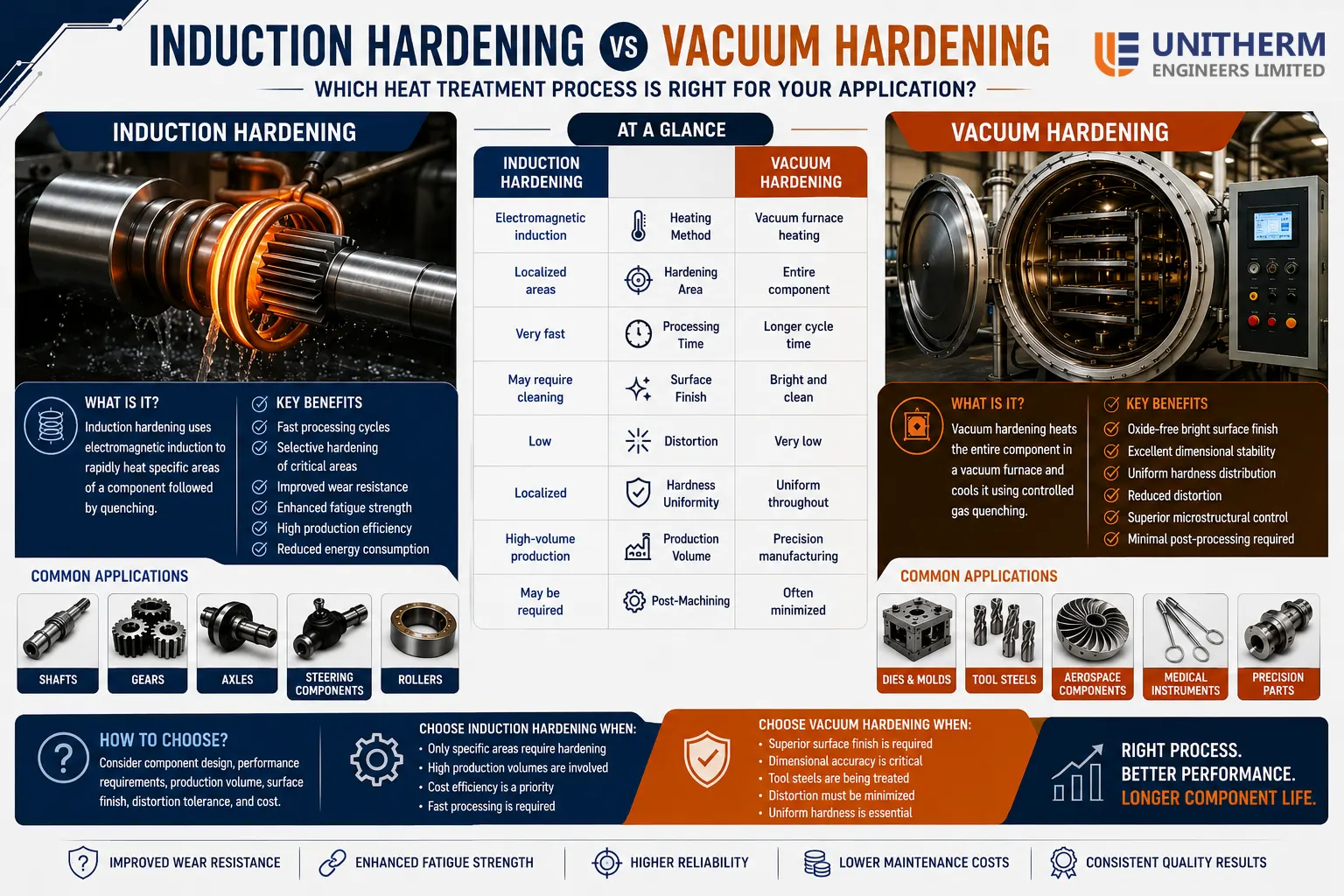
Induction Hardening vs Vacuum Hardening: Process Comparison
| Parameter |
Induction Hardening |
Vacuum Hardening |
| Heating Method |
Electromagnetic induction |
Vacuum furnace heating |
| Hardening Area |
Localized areas |
Entire component |
| Processing Time |
Very fast |
Longer cycle time |
| Surface Finish |
May require cleaning |
Bright and clean |
| Distortion |
Low |
Very low |
| Hardness Uniformity |
Localized |
Uniform throughout |
| Production Volume |
High-volume production |
Precision manufacturing |
| Post-Machining |
May be required |
Often minimized |
The choice between the two depends largely on component requirements and production goals.
Microstructure Development
The microstructure produced by each process directly influences component performance.
Induction Hardening Microstructure
Induction hardening creates a hardened martensitic surface layer while preserving the original core structure.
Characteristics include:
- High surface hardness
- Tough and ductile core
- Excellent wear resistance
- Improved fatigue strength
The hardened case depth can be controlled by adjusting frequency, power, and heating duration.
Vacuum Hardening Microstructure
Vacuum hardening produces a more uniform microstructure throughout the component.
Key characteristics include:
- Uniform martensitic structure
- Controlled carbide distribution
- Reduced retained austenite
- Improved dimensional stability
This consistent microstructure is particularly beneficial for tooling and precision engineering applications.
Distortion and Dimensional Stability Comparison
Distortion control is often one of the most important considerations in heat treatment.
Induction Hardening
Because only selected areas are heated, induction hardening generally produces lower overall distortion than traditional furnace hardening.
Advantages include:
- Reduced thermal expansion
- Minimal deformation
- Suitable for large components
However, improper process control can still lead to localized distortion.
Vacuum Hardening
Vacuum hardening is known for exceptional dimensional stability.
Benefits include:
- Uniform heating
- Controlled cooling rates
- Reduced thermal stress
- Minimal shape distortion
This often reduces or eliminates the need for costly post-heat-treatment machining operations.
Surface Quality Comparison
Induction Hardening Surface Quality
During induction hardening:
- Some oxidation may occur
- Scale formation is possible
- Additional cleaning may be required
The extent of oxidation depends on process conditions and material type.
Vacuum Hardening Surface Quality
Vacuum hardening provides:
- Oxide-free surfaces
- No decarburization
- Clean, bright finish
- Superior surface integrity
This is especially important for precision tools, molds, and aerospace components where surface quality directly impacts performance.
Performance Comparison
Wear Resistance
Both processes offer excellent
wear resistance through martensitic hardening.
Induction hardening excels in applications requiring localized wear protection, while
vacuum hardening provides consistent wear resistance across the entire component.
Fatigue Strength
Induction hardening creates compressive stresses near the surface, improving fatigue performance in rotating and cyclically loaded parts.
Vacuum hardening offers uniform mechanical properties that enhance overall fatigue resistance.
Tool Life
For tooling applications, vacuum hardening often provides superior tool life due to:
- Uniform hardness
- Controlled carbide distribution
- Reduced microstructural inconsistencies
Load-Bearing Capacity
Both processes improve load-bearing capability, but the ideal choice depends on whether localized or full-component hardening is required.
Cost Comparison
Induction Hardening
Advantages:
- Lower cost per component
- Faster production cycles
- High throughput
- Energy-efficient processing
Best suited for:
- Automotive manufacturing
- Mass production environments
- High-volume components
Vacuum Hardening
Advantages:
- Higher quality finish
- Reduced rework costs
- Improved dimensional accuracy
- Better process consistency
Best suited for:
- Precision components
- Tool steels
- Aerospace applications
- High-value parts
While vacuum hardening typically has a higher initial processing cost, it can reduce total manufacturing costs by minimizing rework and post-machining requirements.
Industry Applications
Automotive Industry
Induction hardening is widely used for:
- Drive shafts
- Axles
- Gears
- Steering components
Tool & Die Industry
Vacuum hardening is preferred for:
- Dies
- Molds
- Punches
- Cutting tools
Aerospace Industry
Vacuum hardening is commonly selected for:
- Structural components
- Landing gear parts
- Precision assemblies
Industrial Machinery
Both processes are used for:
- Bearings
- Rollers
- Power transmission components
- Heavy-duty mechanical systems
How to Choose Between Induction Hardening and Vacuum Hardening
Several factors should be considered when selecting the right process:
Choose Induction Hardening When:
- Only specific areas require hardening
- High production volumes are involved
- Cost efficiency is a priority
- Fast processing is required
Choose Vacuum Hardening When:
- Superior surface finish is required
- Dimensional accuracy is critical
- Tool steels are being treated
- Distortion must be minimized
- Uniform hardness is essential
Working with
experienced heat treatment specialists helps ensure the process aligns with performance and manufacturing objectives.
Common Challenges and Best Practices
Induction Hardening Challenges
- Uneven heating
- Inconsistent case depth
- Surface cracking
Vacuum Hardening Challenges
- Longer cycle times
- Higher equipment costs
- Complex process control requirements
Best Practices
- Regular furnace calibration
- Process validation
- Hardness testing
- Metallurgical inspections
- Microstructure analysis
Proper quality control ensures consistent and reliable results regardless of the selected process.
Conclusion
When comparing Induction Hardening vs Vacuum Hardening, it becomes clear that both processes offer unique advantages. Induction hardening is ideal for localized hardening, high production volumes, and cost-effective manufacturing. Vacuum hardening, on the other hand, provides superior surface quality, dimensional stability, and microstructural consistency for precision and high-performance applications.
The best choice ultimately depends on component geometry, material type, hardness requirements, production volume, and quality expectations. By understanding the strengths of each process, manufacturers can make informed decisions that improve component performance, reliability, and long-term value.
FAQs-Case Hardening for Wear Resistance
1.What is the difference between induction hardening and vacuum hardening?
The primary difference between Induction Hardening vs Vacuum Hardening is the heating method and hardening area. Induction hardening uses electromagnetic heating to harden specific surface areas, while vacuum hardening heats the entire component in a controlled vacuum environment, resulting in uniform hardness and superior surface quality.
2.Which process provides better surface finish: induction hardening or vacuum hardening?
Vacuum hardening provides a superior surface finish because the process occurs in an oxygen-free environment, preventing oxidation and decarburization. Components typically emerge with a clean, bright surface that requires minimal post-processing.
3.Is induction hardening more cost-effective than vacuum hardening?
Yes, induction hardening is generally more cost-effective for high-volume production because of its faster cycle times, lower energy consumption, and ability to selectively harden specific areas. Vacuum hardening may have higher processing costs but offers greater precision and surface quality.
4.Which process causes less distortion?
Both processes produce less distortion than conventional hardening methods, but vacuum hardening typically offers the best dimensional stability due to controlled heating and gas quenching. It is often preferred for precision components with tight tolerances.
5.What materials are suitable for induction hardening?
Induction hardening is commonly used for:
- Low-carbon steels
- Alloy steels
- Tool steels
- Gear steels
These materials can develop a hardened martensitic surface layer after rapid heating and quenching.
6.What materials are commonly vacuum hardened?
Vacuum hardening is widely used for:
- Tool steels
- High-alloy steels
- Die steels
- Mold steels
- Aerospace-grade materials
The process provides uniform hardness and excellent microstructural control.
7.Which process offers better wear resistance?
Both processes can provide excellent wear resistance. Induction hardening is highly effective for localized wear-prone areas, while vacuum hardening delivers consistent wear resistance throughout the entire component.