In modern manufacturing, achieving superior wear resistance, fatigue strength, and dimensional stability is critical for extending component life and improving operational performance. Among the various
surface hardening processes available today, the
Nitriding Process has emerged as one of the most effective solutions for enhancing the surface properties of steel components without causing significant distortion.
Unlike conventional hardening methods that require high temperatures and rapid quenching, nitriding introduces nitrogen into the material surface at relatively low temperatures. This creates a hardened surface layer with excellent wear resistance while maintaining the core toughness of the component.
From
automotive gears and crankshafts to aerospace components and industrial tooling, the
Nitriding Process continues to be a preferred
surface hardening process for manufacturers seeking improved reliability and longer service life.
What is the Nitriding Process?
The
Nitriding Process is a thermochemical
heat treatment method that introduces nitrogen into the surface of steel and alloy components. The process is typically carried out at temperatures ranging between
480°C and 580°C, which are below the steel's transformation temperature.
During nitriding, nitrogen atoms diffuse into the material surface, forming hard nitrides that significantly increase
surface hardness and wear resistance.
One of the major advantages of nitriding is that it does not require quenching. As a result, components experience minimal distortion and maintain excellent dimensional stability after treatment.
The process is widely used for parts requiring:
-
High wear resistance
-
Improved fatigue performance
-
Better galling resistance
-
Enhanced surface durability
How the Nitriding Process Works
The
nitriding process involves several carefully controlled stages to ensure consistent results.
Surface Preparation
Before nitriding begins, components are thoroughly cleaned to remove oil, grease, rust, and contaminants. Proper surface preparation is essential because contaminants can interfere with nitrogen diffusion.
Furnace Loading
Components are loaded into a
controlled atmosphere furnace designed specifically for nitriding applications. Proper spacing ensures uniform nitrogen exposure throughout the batch.
Nitrogen Diffusion Stage
Ammonia gas is introduced into the furnace. At elevated temperatures, ammonia decomposes into nitrogen and hydrogen.
The nitrogen atoms penetrate the steel surface and diffuse inward, creating a hardened layer through metallurgical reactions.
Controlled Cooling
Since nitriding does not require rapid quenching, components are cooled gradually within the furnace, minimizing thermal stresses and dimensional changes.
Types of Nitriding Processes
Several nitriding methods are used depending on the application and performance requirements.
Gas Nitriding
Gas nitriding is the most commonly used process. Components are exposed to ammonia-rich atmospheres, allowing nitrogen to diffuse into the surface over extended treatment cycles.
Advantages:
- Proven technology
- Consistent case depth
- Suitable for large batches
Advantages:
- Faster diffusion rates
- Better process control
- Reduced treatment time
- Improved uniformity
Salt Bath Nitriding
This process immerses components in molten salt baths containing nitrogen-bearing compounds.
Advantages:
- Fast treatment cycles
- Uniform surface properties
- Suitable for high-volume production
Each method offers unique advantages depending on component geometry, material type, and production requirements.
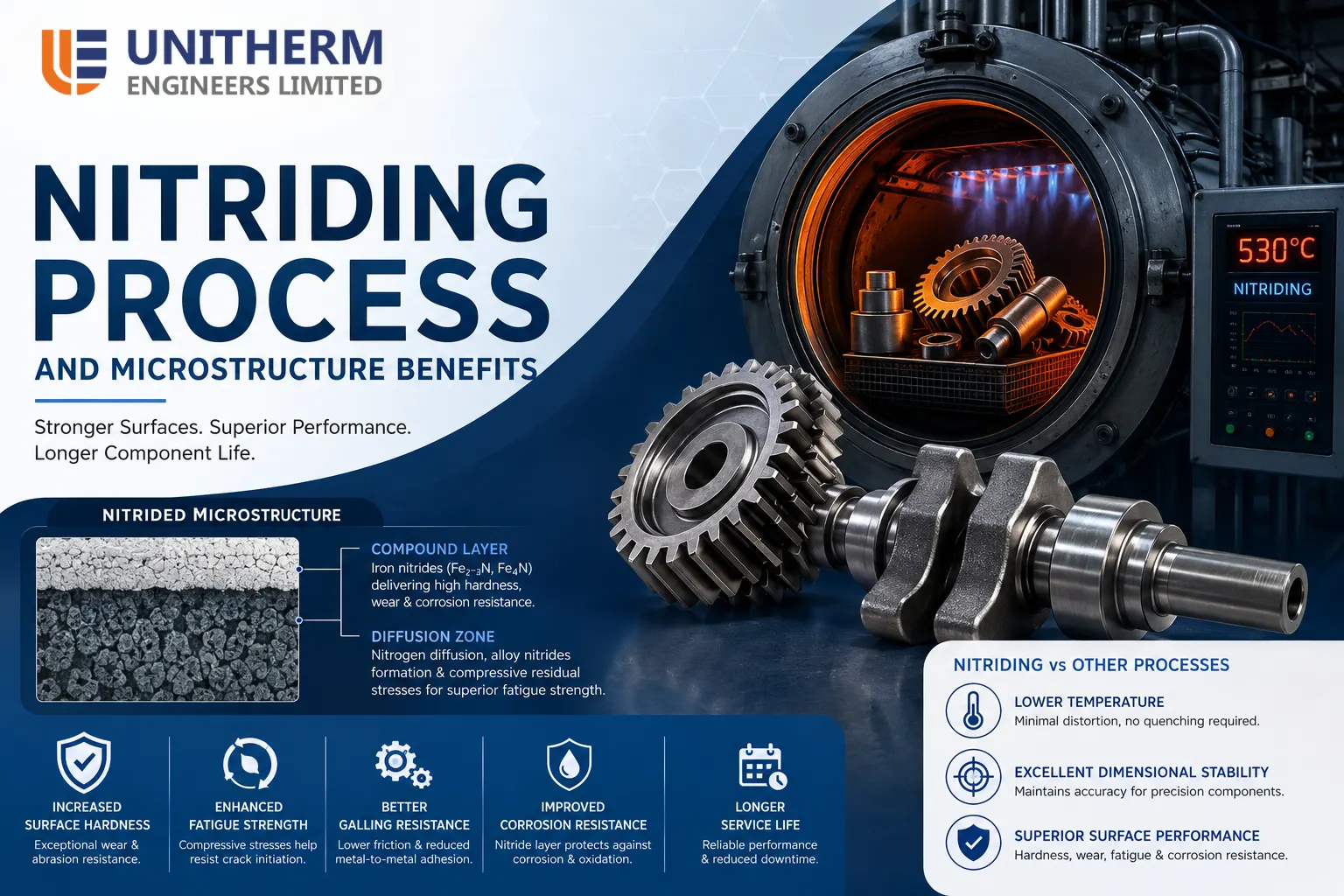
Microstructure Formation During Nitriding
One of the most significant advantages of the
Nitriding Process is the unique microstructure it creates.
Compound Layer (White Layer)
The outermost layer formed during nitriding is known as the compound layer or white layer.
This layer consists primarily of:
- Iron nitrides (Fe₂–₃N)
- Iron nitride compounds (Fe₄N)
The compound layer provides:
- Extremely high surface hardness
- Excellent wear resistance
- Improved corrosion resistance
Diffusion Zone
Beneath the compound layer lies the diffusion zone.
In this region:
- Nitrogen atoms penetrate deeper into the steel
- Alloy nitrides form with elements such as chromium, molybdenum, and aluminum
- Compressive residual stresses develop
The diffusion zone contributes significantly to fatigue resistance and mechanical performance.
This unique nitrided microstructure distinguishes the process from many other
surface hardening processes.
Microstructure Benefits of the Nitriding Process
Increased Surface Hardness
The formation of nitrides produces exceptionally high
surface hardness, often exceeding that achieved by conventional hardening methods.
This results in:
- Improved abrasion resistance
- Reduced surface wear
- Longer component life
Enhanced Fatigue Strength
The compressive residual stresses generated within the diffusion zone help prevent crack initiation and propagation.
This is particularly beneficial for components subjected to cyclic loading.
Better Galling Resistance
Nitrided surfaces exhibit lower friction and reduced metal-to-metal adhesion, minimizing galling and seizure risks.
Improved Corrosion Resistance
The nitride layer provides additional protection against corrosion and environmental degradation.
Longer Service Life
The combination of hardness, wear resistance, and fatigue strength significantly extends component lifespan and reduces maintenance costs.
Nitriding vs Other Surface Hardening Processes
Nitriding vs Carburizing
Carburizing introduces carbon into the steel surface at higher temperatures and requires quenching.
Nitriding offers:
- Lower distortion
- Better dimensional stability
- No quenching requirement
Nitriding vs Carbonitriding
Carbonitriding introduces both carbon and nitrogen but generally creates shallower cases.
Nitriding often provides:
- Superior fatigue resistance
- Improved dimensional accuracy
Nitriding vs Induction Hardening
Induction hardening provides localized
surface hardening through rapid heating.
Nitriding offers:
- Uniform diffusion-based hardening
- Better wear performance on complex geometries
Applications of Nitriding
The
Nitriding Process is widely used across multiple industries.
Automotive Industry
- Crankshafts
- Camshafts
- Gears
- Valve components
Tooling Industry
- Dies
- Molds
- Extrusion tools
Aerospace Industry
- Landing gear components
- Turbine shafts
- High-performance structural parts
Industrial Equipment
- Bearings
- Hydraulic rods
- Pump components
- Power transmission shafts
These applications benefit from improved durability and reduced maintenance requirements.
Why Manufacturers Choose Nitriding
Manufacturers increasingly select nitriding because it provides:
- Exceptional wear resistance
- Improved fatigue performance
- Minimal distortion
- No quenching requirement
- Enhanced dimensional stability
- Lower lifecycle costs
For precision-engineered components, these benefits often translate into significant productivity and cost advantages.
Choosing the Right Nitriding Service Provider
Selecting the right heat treatment partner is critical to achieving consistent nitriding results.
When searching for a "
nitriding process near me," manufacturers should evaluate:
- Furnace technology
- Process control capabilities
- Metallurgical expertise
- Quality certifications
- Inspection and testing facilities
An experienced provider can optimize process parameters to achieve the desired hardness, case depth, and microstructure.
Conclusion
The Nitriding Process is one of the most effective surface hardening processes available for improving wear resistance, fatigue strength, and component durability. Its ability to create a hard, nitrogen-enriched surface while maintaining dimensional stability makes it an ideal solution for automotive, aerospace, tooling, and industrial applications.
The unique microstructure formed during nitriding—consisting of a hard compound layer and a supportive diffusion zone—delivers outstanding performance under demanding operating conditions. As industries continue to demand higher reliability and longer component life, nitriding remains a preferred heat treatment solution for precision-engineered parts.
FAQs-Nitriding Process and Microstructure Benefits
1.What is the nitriding process?
The nitriding process is a thermochemical heat treatment method that diffuses nitrogen into the surface of steel components to improve hardness, wear resistance, fatigue strength, and surface durability. Unlike carburizing, nitriding is performed at lower temperatures and does not require quenching.
2.How does the nitriding process improve surface hardness?
During the nitriding process, nitrogen atoms diffuse into the steel surface and form hard nitride compounds. These nitrides create a highly wear-resistant surface layer that significantly increases hardness and extends component life.
3.What are the main microstructure benefits of nitriding?
The nitriding process creates two important microstructural regions:
- Compound Layer (White Layer): Provides high surface hardness and wear resistance.
- Diffusion Zone:Generates compressive residual stresses that improve fatigue strength and crack resistance.
Together, these layers enhance overall component performance.
4.What materials are suitable for the nitriding process?
Nitriding is commonly applied to:
- Alloy steels
- Tool steels
- Stainless steels
- Nitriding-grade steels containing chromium, molybdenum, aluminum, or vanadium
5.How does nitriding compare to other surface hardening processes?
Compared to carburizing and induction hardening, the nitriding process offers:
- Lower distortion
- No quenching requirement
- Better dimensional stability
- Excellent wear resistance
- Improved fatigue performance
However, nitriding generally produces a shallower case depth than carburizing.
6.What industries commonly use the nitriding process?
The nitriding process is widely used in:
- Automotive manufacturing
- Aerospace engineering
- Tool and die production
- Industrial machinery
- Power transmission equipment
Applications include gears, crankshafts, camshafts, molds, dies, bearings, and hydraulic components.